
Judah, Tamar, and the Courage to Recognize the Truth
Weekly Portion: וַיֵּשֶׁב — Vayeshev | And He Settled
Old Testament: Genesis 38:20–26
New Testament: Romans 14:11–17
Augmented Study: Genesis 37:26–33; 38:11–26
Date: Sunday, November 29th, 2026
WE CANNOT BEGIN TO REPAIR WHAT WE REFUSE TO RECOGNIZE.
New Testament
Romans 14:11–17
11 For it is written,
“As I live, says the Lord, every knee shall bow to me,
and every tongue shall give praise to God.”
12 So then, each one of us will be held accountable.
Do Not Make Another Stumble
13 Let us therefore no longer pass judgment on one another, but resolve instead never to put a stumbling block or hindrance in the way of a brother or sister.
14 I know and am persuaded in the Lord Jesus that nothing is unclean in itself, but it is unclean for anyone who considers it unclean.
15 If your brother or sister is distressed by what you eat, you are no longer walking in love. Do not let what you eat cause the ruin of one for whom Christ died.
16 So do not let your good be slandered.
17 For the kingdom of God is not food and drink but righteousness and peace and joy in the Holy Spirit.
Old Testament
Genesis 38:20-26
20 When Judah sent the kid by his friend the Adullamite to recover the pledge from the woman, he could not find her.
21 He asked the townspeople, “Where is the prostitute who was at Enaim by the wayside?” But they said, “No prostitute has been here.”
22 So he returned to Judah and said, “I have not found her; moreover, the townspeople said, ‘No prostitute has been here.’ ”
23 Judah replied, “Let her keep the things as her own, otherwise we will be laughed at; you see, I sent this kid, and you could not find her.”
24 About three months later Judah was told, “Your daughter-in-law Tamar has prostituted herself; moreover, she is pregnant as a result of prostitution.” And Judah said, “Bring her out, and let her be burned.”
25 As she was being brought out, she sent word to her father-in-law, “It was the owner of these who made me pregnant.” And she said, “Take note, please, whose these are, the signet and the cord and the staff.”
26 Then Judah acknowledged them and said, “She is more in the right than I, since I did not give her to my son Shelah.” And he did not lie with her again.
THE LITERARY STRUCTURE
Chiastic structure of Genesis 38:1–30
From broken relationships to renewed life
A — 1–5: Judah establishes a family.
B — 6–10: Death and unrighteousness.
C — 11: Judah sends Tamar away.
D — 12–19: Tamar acts to secure her rights.
C′ — 20–23: Judah attempts to recover his possessions.
B′ — 24–26: Life preserved through acknowledged righteousness.
A′ — 27–30: Judah's family continues through Tamar.
Our reading: Genesis 38:20–26 (C′–B′)
Central axis: Tamar acts to secure what has been denied.
Adapted from Walter Hilbrands and Hans-Georg Wünch (2012).
Chiastic structure of Romans 14:13b–21
From personal conviction to communal righteousness
A — 13b: Do not cause another to stumble.
B — 14: Recognize individual convictions.
C — 15: Walk in love rather than cause harm.
D — 16: Do not allow good to become harmful.
E — 17: Righteousness, peace, and joy in the Holy Spirit.
D′ — 18–19: Serve God and build up one another.
C′ — 20a: Do not destroy God's work.
B′ — 20b: Respect individual convictions.
A′ — 21: Avoid causing another to stumble.
Our reading: Romans 14:11–17 (Introduction through E)
Central axis: Righteousness, peace, and joy in the Holy Spirit.
Adapted from Iver Larsen's expansion of Douglas Moo's proposed chiastic structure.
The three pledges
חוֹתָם — Chotam | Signet
A personal seal used to authenticate identity and transactions.
Who are you?
פָּתִיל — Patil | Cord
A cord possibly used to suspend or carry the personal seal.
What identifies you?
מַטֶּה — Matteh | Staff
A personal implement that could also signify position and authority.
How do you exercise your authority?
Together, these possessions establish Judah's identity. The three accompanying questions are homiletical applications, not established ancient symbolic meanings.
PaRDeS | FOUR WAYS OF ENTERING THE TEXT
Exploring the parashah through four interpretive approaches
Peshat — פְּשָׁט
The plain meaning
Judah fails to fulfill his obligation to Tamar, condemns her when she becomes pregnant, and subsequently acknowledges that she has acted more rightly than he has.
The immediate concern is familial responsibility, justice, and the consequences of neglected obligations.
Remez — רֶמֶז
The literary hint
The repetition of hakker-na in Genesis 37:32 and 38:25 connects the deception of Jacob with the exposure of Judah.
In both encounters, personal possessions demand recognition. However, the second encounter reverses the moral direction of the first.
Derash — דְּרַשׁ
The interpretive teaching
Rabbi Yohanan, in the rabbinic tradition, explicitly connects Judah's words to his father with the words Tamar subsequently directs toward Judah.
The demand for recognition returns to the person associated with its earlier use. This is an example of the rabbinic principle of measure for measure.
Sod — סוֹד
The deeper spiritual contemplation
What if the circumstances we most readily condemn become opportunities through which God invites us to examine ourselves?
Judah's encounter with Tamar invites contemplation of divine justice, human freedom, and the possibility of moral transformation.
This is a spiritual reflection rather than a claim of an established mystical interpretation.
Closing reflection
We began this morning with two words: Hakker-na. Recognize, please.
Jacob recognized a garment but was deceived. Judah recognized his possessions and acknowledged his wrongdoing. Paul invites us to redirect our judgment toward our own conduct and the consequences it produces for others.
Perhaps the greatest evidence of spiritual maturity is not how effectively we expose the failures of others, but how faithfully we respond when the truth exposes our own. Judah's transformation begins when he becomes willing to say that someone else is right.
Recognition opens the door to accountability. Accountability opens the door to repair. And through repair, righteousness and peace become more than words we proclaim. They become realities we help establish.
Call and Response
Leader: When we recognize the shortcomings of others,
People: Teach us also to recognize our own.
Leader: When our reputation stands in the way of righteousness,
People: Give us the courage to acknowledge the truth.
Leader: When our actions become a stumbling block,
People: Teach us to walk in love.
Leader: May our lives reflect righteousness, peace, and joy.
All: May the work of our hands reflect the goodness of God. Amen.
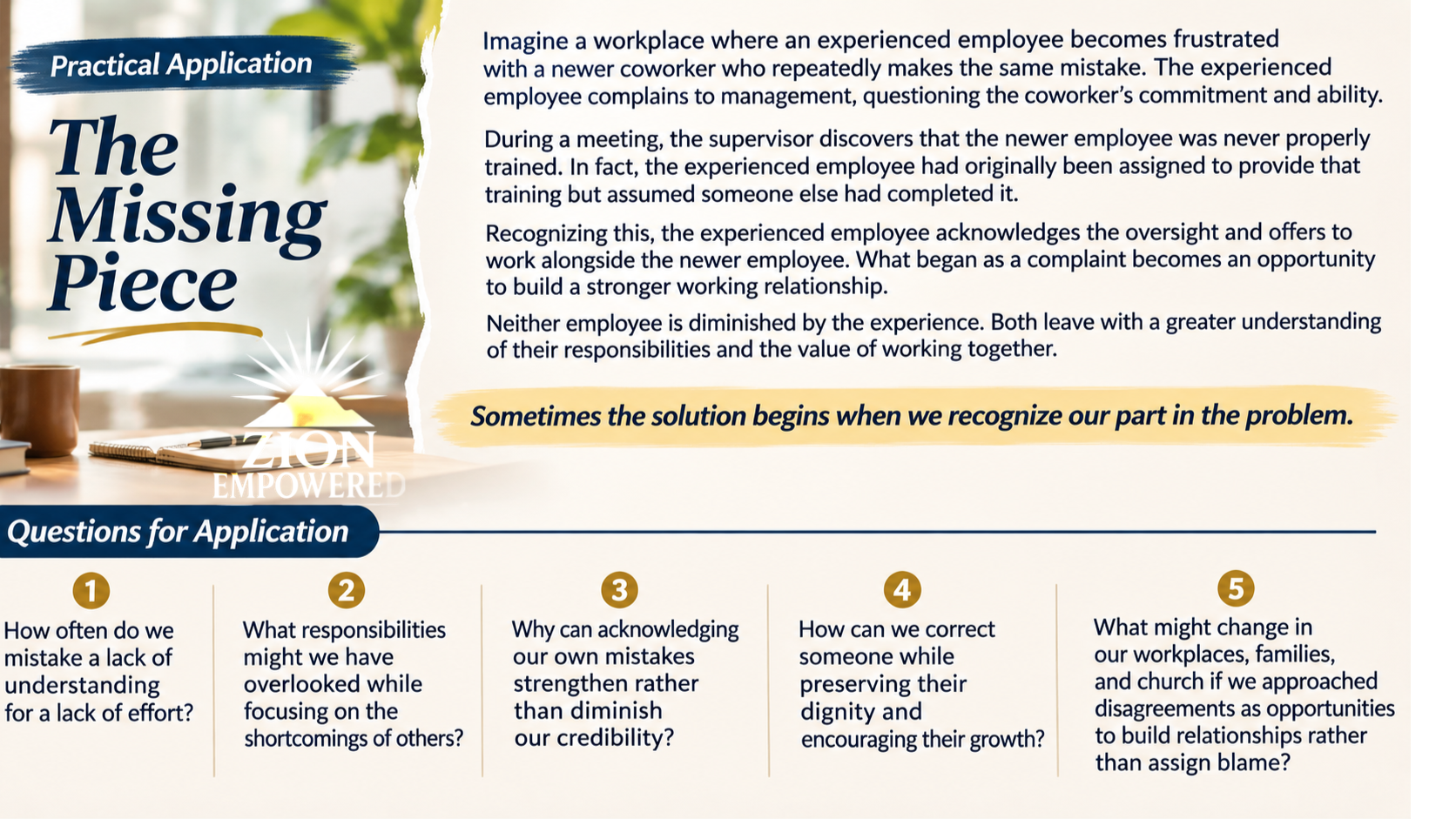
Practical Application | The Missing Piece
Imagine a workplace where an experienced employee becomes frustrated with a newer coworker who repeatedly makes the same mistake. The experienced employee complains to management, questioning the coworker's commitment and ability.
During a meeting, the supervisor discovers that the newer employee was never properly trained. In fact, the experienced employee had originally been assigned to provide that training but assumed someone else had completed it.
Recognizing this, the experienced employee acknowledges the oversight and offers to work alongside the newer employee. What began as a complaint becomes an opportunity to build a stronger working relationship.
Neither employee is diminished by the experience. Both leave with a greater understanding of their responsibilities and the value of working together.
Sometimes the solution begins when we recognize our part in the problem.
Questions for Application
1. How often do we mistake a lack of understanding for a lack of effort?
2. What responsibilities might we have overlooked while focusing on the shortcomings of others?
3. Why can acknowledging our own mistakes strengthen rather than diminish our credibility?
4. How can we correct someone while preserving their dignity and encouraging their growth?
5. What might change in our workplaces, families, and church if we approached disagreements as opportunities to build relationships rather than assign blame?
Words to remember
הַכֶּר־נָא — Hakker-na
Recognize, please; an invitation to examine.
וַיַּכֵּר — Vayakker
And he recognized; acknowledging the truth.
צָדְקָה — Tzadkah
She is in the right; acknowledging justice.
κρίνω — Krinō
To judge, distinguish, or decide.
δικαιοσύνη — Dikaiosynē
Righteousness, justice, or uprightness.
Literary Discovery | Romans 14:13
κρίνωμεν — Krinōmen
Let us judge.
κρίνατε — Krinate
Decide or determine.
Paul uses the same Greek verb to redirect our attention from judging others to examining our own conduct.
Three Names to Remember
יְהוּדָה — Yehudah | Judah
Meaning: Praise or thanksgiving.
Reflection: Humility to acknowledge the truth.
תָּמָר — Tamar | Tamar
Meaning: Date palm.
Reflection: Courage and resilience amid adversity.
פֶּרֶץ — Peretz | Perez
Meaning: Breach or breakthrough.
Reflection: Renewal beyond broken circumstances.
Scripture: Genesis 38:29; Ruth 4:18–22; Matthew 1:3.
*Significance: Son of Judah and Tamar, ancestor of King David and Jesus Christ.
Reflection: Renewal, redemption, and hope emerging from broken circumstances.
Humility to recognize. Courage to respond. Hope to begin again.¨
