WHEN THE WALLS FALL, KEEP YOUR WORD
Chesed After Victory
New Testament: Matthew 22:34-40
Old Testament: Joshua 2:8-14 | Joshua 6:16-25
Date: September 27, 2026
The deepest test of faith may not be whether God gives us victory, but whether victory changes the way we treat the people we once needed. Love of God becomes visible when power increases and our capacity for covenant memory increases with it.
Matthew 22:34-40
The Greatest Commandments
34 When the Pharisees heard that he had silenced the Sadducees, they gathered together,
35 and one of them, an expert in the law, asked him a question to test him.
36 “Teacher, which commandment in the law is the greatest?”
37 He said to him, “ ‘You shall love the Lord your God with all your heart and with all your soul and with all your mind.’
38 This is the greatest and first commandment.
39 And a second is like it: ‘You shall love your neighbor as yourself.’
40 On these two commandments hang all the Law and the Prophets.”
Joshua 2:8-14
Rahab's Faith in Israel's God
8 Before they went to sleep, she came up to them on the roof
9 and said to the men, “I know that the Lord has given you the land and that dread of you has fallen on us and that all the inhabitants of the land melt in fear before you.
10 For we have heard how the Lord dried up the water of the Red Sea before you when you came out of Egypt and what you did to the two kings of the Amorites who were beyond the Jordan, to Sihon and Og, whom you utterly destroyed.
11 As soon as we heard it, our hearts melted, and there was no courage left in any of us because of you. The Lord your God is indeed God in heaven above and on earth below.
12 Now then, since I have dealt kindly with you, swear to me by the Lord that you in turn will deal kindly with my family. Give me a sign of good faith
13 that you will spare my father and mother, my brothers and sisters, and all who belong to them and deliver our lives from death.”
14 The men said to her, “Our life for yours! If you do not tell this business of ours, then we will deal kindly and faithfully with you when the Lord gives us the land.”
Joshua 6:16-25
Rahab Is Spared
16 And at the seventh time, when the priests had blown the trumpets, Joshua said to the people, “Shout! For the Lord has given you the city. 17 The city and all that is in it shall be devoted to the Lord for destruction. Only Rahab the prostitute and all who are with her in her house shall live because she hid the messengers we sent. 18 As for you, keep away from the things devoted to destruction, so as not to covet and take any of the devoted things and make the camp of Israel an object for destruction, bringing trouble upon it. 19 But all silver and gold and vessels of bronze and iron are sacred to the Lord; they shall go into the treasury of the Lord.” 20 So the people shouted, and the trumpets were blown. As soon as the people heard the sound of the trumpets, they raised a great shout, and the wall fell down flat, so the people charged straight ahead into the city and captured it. 21 Then they devoted to destruction by the edge of the sword all in the city, both men and women, young and old, oxen, sheep, and donkeys.
22 But to the two men who had spied out the land, Joshua said, “Go into the prostitute’s house, and bring the woman out of it and all who belong to her, as you swore to her.” 23 So the young men who had been spies went in and brought Rahab out, along with her father, her mother, her brothers, and all who belonged to her—they brought all her kindred out—and set them outside the camp of Israel. 24 They burned down the city and everything in it; only the silver and gold and the vessels of bronze and iron they put into the treasury of the house of the Lord. 25 But Rahab the prostitute, with her family and all who belonged to her, Joshua spared. Her family has lived in Israel ever since. For she hid the messengers whom Joshua sent to spy out Jericho.
Chiastic Review
Mathew 22
(Hebraic concentric movement less than a strict chiasm)
A — THE KING INVITES
Matthew 22:1-14, Wedding Banquet
The king invites people into the feast, some refuse, others are gathered from the roads. The question is: Who will respond rightly to the king?
B — CAESAR AND GOD
Matthew 22:15-22
The Pharisees and Herodians test Jesus about taxes.
“Render to Caesar what is Caesar’s, and to God what is God’s.”
The question becomes: To whom do you ultimately belong?
C — RESURRECTION AND THE GOD OF THE LIVING
Matthew 22:23-33
The Sadducees test Jesus concerning resurrection.
Jesus answers that God is:
“not God of the dead, but of the living.”
This is close to the chapter’s theological center because the argument shifts from political obligation to the very nature of God, life, covenant, and resurrection.
B′ — LOVE GOD AND NEIGHBOR
Matthew 22:34-40
Now a Pharisee asks about Torah.
Jesus answers:
Love God completely.
Love your neighbor as yourself.
The earlier question, “What belongs to God?” now receives a deeper answer:
You do.
Heart. Soul. Mind.
And belonging to God necessarily changes how you treat the neighbor.
A′ — WHO IS THE MESSIAH?
Matthew 22:41-46
Jesus stops answering questions and asks one.
“What do you think of the Messiah? Whose son is he?”
They answer, “David’s.”
Jesus presses them with Psalm 110: if David calls the Messiah “Lord,” how can he merely be David’s son?
The chapter began with people responding to the king’s invitation and ends with people being forced to confront the identity of the King standing before them.
THE HIDDEN CENTER
What Belongs to God?
A few verses before Jesus gives the greatest commandments, he says:
“Give to God the things that are God’s.”
Matthew 22:21
Then, in Matthew 22:37, he says:
“Love the Lord your God with all your heart, and with all your soul, and with all your mind.”
That raises a deeper question:
What exactly belongs to God?
Matthew seems to answer:
All of you.
JOSHUA 6
The Wall Falls, the Promise Stands
Joshua 6 is usually remembered as the story of a wall coming down. But the literary structure asks us to notice something deeper: victory is surrounded by restraint, covenant, and memory.
THE LARGER MOVEMENT
A — JERICHO LOOKS SECURE
Joshua 6:1-2
Jericho is shut tight, yet God declares that the city has already been given into Israel's hands.
↓
B — GOD GIVES THE PATTERN
Joshua 6:3-5
Priests. Trumpets. Ark. Circuits. Silence. Seven days. Israel does not invent the strategy; Israel receives it.
↓
C — JOSHUA GIVES THE COMMAND
Joshua 6:6-10
What God speaks to Joshua becomes what Joshua teaches the people.
↓
D — ISRAEL WALKS IN OBEDIENCE
Joshua 6:11-14
Before there is shouting, there is disciplined walking. Before the spectacular moment comes repeated obedience.
↓
CENTER — VICTORY HAS BOUNDARIES
Joshua 6:15-19
Israel receives three instructions at the moment victory arrives:
The city belongs to God.
Do not turn God's victory into private gain.
Rahab and her household must live.
The wall is about to fall, but Israel is already being taught:
Winning does not give you permission to forget covenant.
↓
D′ — ISRAEL SHOUTS AND THE WALL FALLS
Joshua 6:20-21
The obedience commanded earlier reaches its appointed moment.
↓
C′ — JOSHUA REMEMBERS THE OATH
Joshua 6:22
Joshua tells the spies:
“Bring the woman out of it and all who belong to her, as you swore to her.”
The military command has been fulfilled; now the covenant promise must also be fulfilled.
↓
B′ — THE INSTRUCTIONS ARE COMPLETED
Joshua 6:23-24
Rahab's household is removed, the city is burned, and the metals devoted to God enter the treasury.
↓
A′ — JERICHO IS GONE, RAHAB REMAINS
Joshua 6:25-27
The city that appeared permanent disappears.
The woman whose future appeared fragile remains.
THE SMALLER CHIASM
Victory Surrounded by Covenant
A — RAHAB MUST LIVE
Joshua 6:17
B — DO NOT TAKE WHAT BELONGS TO GOD
Joshua 6:18-19
C — THE WALL FALLS
Joshua 6:20-21
B′ — WHAT BELONGS TO GOD GOES TO GOD
Joshua 6:24
A′ — RAHAB LIVES
Joshua 6:22-25
WHAT SURROUNDS THE VICTORY?
Before the wall falls, Israel is told to restrain its appetite and remember Rahab.
After the wall falls, Israel must restrain its appetite and remember Rahab.
The structure makes the point:
VICTORY IS ENCLOSED BY OBEDIENCE.
THE RAHAB REVERSAL
Joshua 2 → Joshua 6
A — THE SPIES ENTER RAHAB'S HOUSE
They arrive vulnerable and dependent upon her protection.
B — RAHAB PROTECTS THE SPIES
She risks herself to preserve their lives.
C — RAHAB ASKS FOR A PROMISE
She asks Israel to show her the same chesed, covenant loyalty, that she has shown them.
C′ — ISRAEL REMEMBERS THE PROMISE
Joshua commands the spies to rescue her “as you swore to her.”
B′ — THE SPIES PROTECT RAHAB
The people she once rescued now rescue her.
A′ — RAHAB LEAVES THE HOUSE ALIVE
The relationship has moved in reverse, but covenant holds it together.
PaRDeS REFLECTION
PESHAT: WHAT DOES THE STORY SAY?
Rahab protects Israel's spies, confesses faith in Israel's God, and requests protection for her household. The spies promise protection, Jericho falls, Joshua remembers the oath, and Rahab's household is spared.
Matthew presents Jesus identifying love of God and love of neighbor as the commandments upon which the Law and Prophets depend. Taken together, the texts place faithful love at the center of covenant identity.
REMEZ: WHAT DOES THE TEXT HINT AT?
Rahab's confession hints that God's reputation has already crossed the Jordan before Israel does. The nations are hearing what God has done, which means Israel's conduct now becomes part of the testimony attached to God's name.
There is also a warning hidden here. It is possible for outsiders to understand something true about God while insiders are still struggling to live consistently beneath that truth.
DRASH: WHAT DOES THE TEXT ASK OF US?
The story asks whether our promises remain dependable after our circumstances improve. It asks whether we remember people once their usefulness to us has ended and whether blessings received through relationship produce deeper loyalty rather than greater independence.
Jesus sharpens the demand. Love of neighbor cannot remain an emotion, because covenant love eventually becomes behavior.
SOD: WHAT MYSTERY SHINES THROUGH?
There is something mysterious about a God whose purposes move through borders, outsiders, whispered agreements, collapsing cities, imperfect people, and fragile promises without losing sight of one household.
The God directing Israel's national story still notices Rahab's roof.
The God bringing down Jericho's walls still remembers the words spoken before they fell.
Perhaps holiness is revealed partly in that scale of attention.
God can govern history without forgetting a house.
God can move nations without overlooking a name.
DISCUSSION QUESTIONS
1. WHO HEARD YOUR TESTIMONY?
What experience in your life may have become evidence of God for somebody else, even though you never considered it particularly remarkable?
How does Rahab change the way we think about people who are watching faith from outside the church?
2. WHO HELPED BEFORE THE WALL FELL?
Who showed you chesed when your future was uncertain, and what does remembering them require from you now?
Is gratitude merely remembering how someone helped, or does gratitude sometimes create continuing responsibility?
3. HAS SUCCESS EVER CHANGED THE TERMS?
Why are promises sometimes easier to make while we need help than to honor after we gain power?
What safeguards keep success from turning covenant into convenience?
4. WHO IS RAHAB IN OUR WORLD?
Who carries a label that causes religious people to underestimate what God may already be doing in their life?
What happens when the church knows someone's history better than it recognizes their faith?
5. WHO CAN GET IN BECAUSE YOU DID?
Where has God given you access, opportunity, influence, knowledge, security, or authority that could create room for somebody else?
What would chesed look like there this week?
Call and Response
Leader: When God brings down the wall, what shall we remember?
People: We will remember the people and the promises.
Leader: When God makes room for us, what shall we do with the room?
People: We will make room for somebody else.
Leader: When circumstances change, what happens to covenant love?
People: Chesed remembers.
Leader: How shall we love the Lord our God?
People: With heart, soul, mind, and all that we are.
Leader: And how shall we love our neighbor?
People: As ourselves, with mercy that becomes action and promises that remain true.
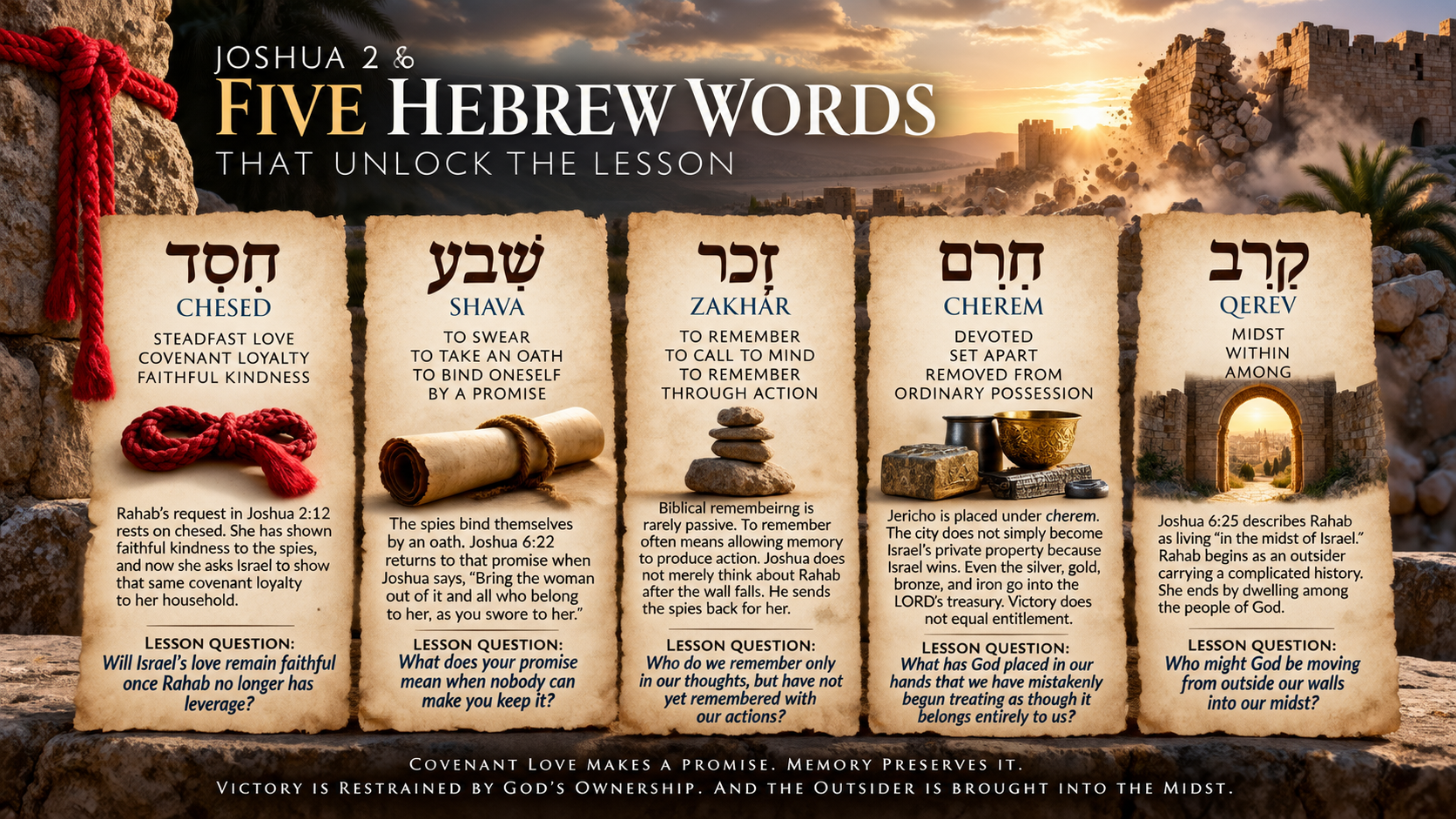
Word Study
חֶסֶד — CHESED
Steadfast Love | Covenant Loyalty | Faithful Kindness
Rahab's request in Joshua 2:12 rests on chesed. She has shown faithful kindness to the spies, and now she asks Israel to show that same covenant loyalty to her household.
Chesed is not mere niceness. It is love with memory, loyalty that remains faithful when circumstances change.
LESSON QUESTION:
Will Israel's love remain faithful once Rahab no longer has leverage?
שָׁבַע — SHAVA
To Swear | To Take an Oath | To Bind Oneself by a Promise
The spies do more than offer reassurance. They bind themselves by an oath.
Joshua 6:22 returns to that promise when Joshua says:
“Bring the woman out of it and all who belong to her, as you swore to her.”
By the time Jericho falls, Rahab cannot force Israel to do anything. She possesses only their word.
LESSON QUESTION:
What does your promise mean when nobody can make you keep it?
זָכַר — ZAKHAR
To Remember | To Call to Mind | To Remember Through Action
Biblical remembering is rarely passive. To remember often means allowing memory to produce action.
Joshua does not merely think about Rahab after the wall falls. He sends the spies back for her.
Israel's memory develops feet.
LESSON QUESTION:
Who do we remember only in our thoughts, but have not yet remembered with our actions?
חֵרֶם — CHEREM
Devoted | Set Apart | Removed From Ordinary Possession
Jericho is placed under cherem. The city does not simply become Israel's private property because Israel wins.
Even the silver, gold, bronze, and iron are directed into the LORD's treasury.
Victory does not equal entitlement.
God gives Israel the city while still placing boundaries around what Israel may take.
LESSON QUESTION:
What has God placed in our hands that we have mistakenly begun treating as though it belongs entirely to us?
קֶרֶב — QEREV
Midst | Within | Among
Joshua 6:25 eventually describes Rahab as living בְּקֶרֶב יִשְׂרָאֵל, b'qerev Yisrael, “in the midst of Israel.”
Watch the movement of grace:
Inside Jericho → Outside the camp → In the midst of Israel
Rahab begins as an outsider carrying a complicated history. She ends by dwelling among the people of God.
Her past remains part of her biography.
It no longer determines her geography.