
ANOTHER WAY
Preamble:
There are moments when a door closes behind you before you fully understand what you have chosen.
Joshua says, “As soon as the pursuers had gone out, the gate was shut.”
I have been thinking about gates this week after moving through Southeast Alaska, Ketchikan, Sitka, Juneau, places where mountains press against the water and the road sometimes simply ends. You do not always get where you are going by continuing straight. Sometimes you have to cross.
That image stayed with me because we return home to a world full of argument. Politics sharpens. Nations divide. People explain what everyone else must change. Yet the prophetic question is more demanding:
What in me must change?
That question is waiting inside Rahab’s house.
Jericho still stands. The king still has power. Israel has not crossed over. Rahab does not know how the story ends, but she knows enough to decide where she will stand within it.
And that matters on this Sunday, because when the sun goes down, the Jewish world enters Yom Kippur, the Day of Atonement.
Yom Kippur asks us to become quiet enough to hear what accusation usually drowns out: confession. Not what they did. Not what the other side did. Not even what the person who wounded us did. The question bends inward: What have I done, what have I left undone, and am I prepared to return?
The Hebrew word is תְּשׁוּבָה — teshuvah: return. Not sorrow as performance, not guilt as theater, but a turning of the life.
Rahab cannot change yesterday. She cannot control Jericho, Israel, the king, or tomorrow. But she possesses one sacred piece of territory: the next thing she does.
Perhaps that is where repentance always begins.
James remembers her not because she had the best theology, but because she welcomed the messengers and sent them out another way.
Another way.
Southeast reminded me that sometimes the old road simply cannot take you where you need to go. The mountain blocks it. The water interrupts it. The map reaches its limit.
And sometimes faith begins with the humility to admit:
I cannot get there from here by remaining who I have been.
The world will continue arguing about who must change.
Yom Kippur asks the harder question:
What road must change beneath my own feet?
Because when living faith enters the house, something must leave by another road.
The Name Beneath the Name
Preamble:
There are seasons when the light begins to change.
Not disappear. Change.
The day seems to measure itself against the night, and for a brief moment neither appears willing to overpower the other.
Creation itself seems to stand in balance.
And perhaps we should too.
There are times when a person ought to stop long enough to ask not simply:
Where am I going?
But:
Who is going there?
Because life has a way of giving us new names.
Leader, Teacher, Reverend, Boss, Graduate, Survivor.
Names earned through work.
Names carried through struggle.
Names spoken over us because somehow we made it through what once looked impossible.
Joshua knew something about that.
He had walked behind Moses through wilderness and disappointment.
He had watched a generation disappear.
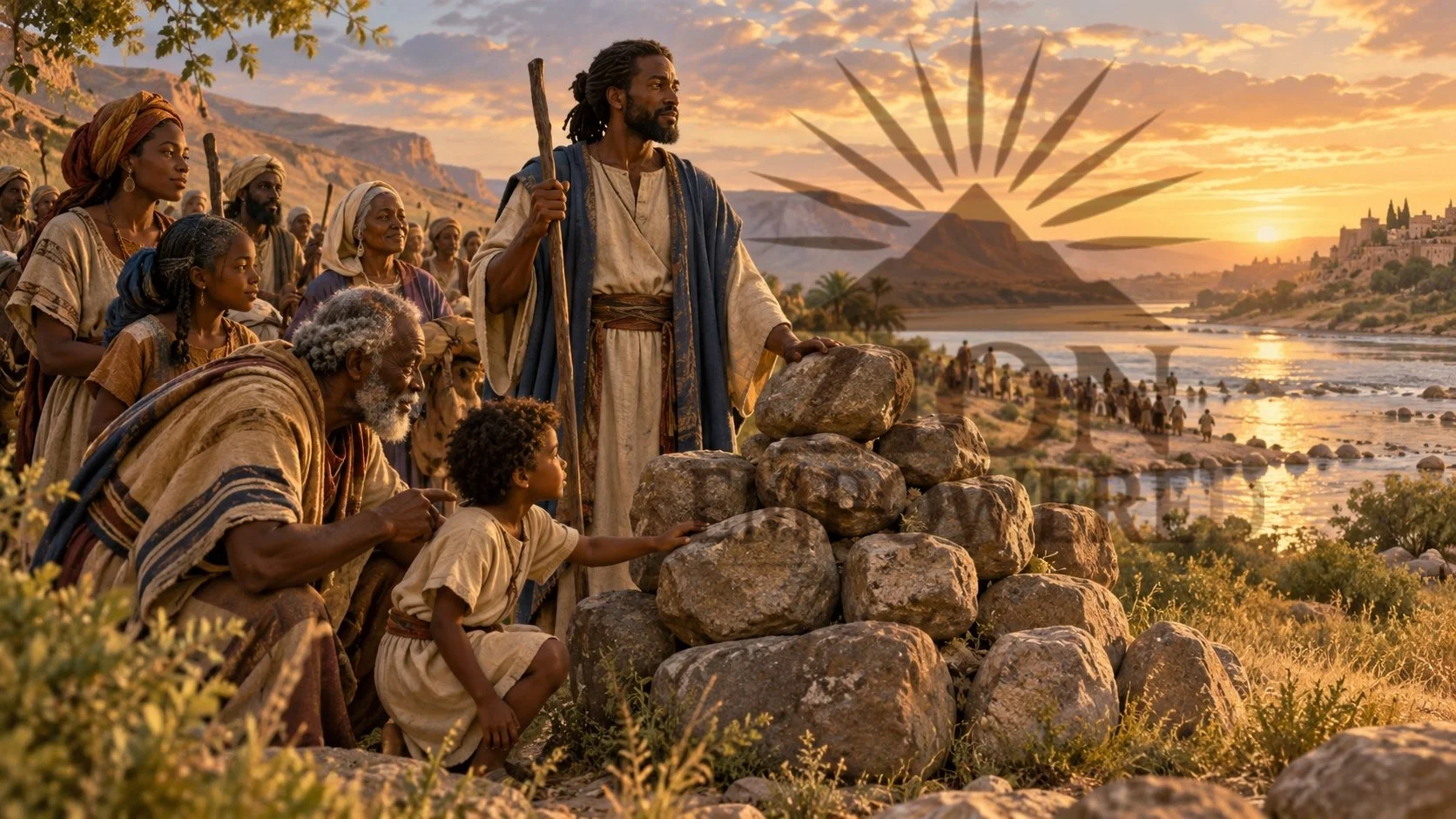
He had carried the expectation of a teacher who could bring Israel to the river but could not cross it with them.
Now the river is before him.
Moses is leaving.
Joshua is rising.
The future appears to know his name.
And then Torah does something curious.
At almost the very moment Joshua is about to become Joshua in the eyes of everybody else, Moses' final song reaches backward and calls him:
Hoshea.
His old name.
The name before the authority.
Before the river opened.
Before the people stood in awe of him.
Before the title became larger than the man.
Why would Scripture reach backward at the very moment his life is moving forward?
A few verses later Moses gives us a clue:
“It is not an empty thing.”
Perhaps that is how sacred text teaches us to read.
Do not hurry past the strange thing.
Do not assume the small detail is small.
Sometimes revelation hides where the sentence refuses to behave as expected.
And so, standing near a river, at the turning of a season, with one leader preparing to leave and another preparing to rise, Torah places an old name in our hands.
Hoshea.
And asks us to examine ourselves.
When life enlarges your name, what happens to the person beneath it?
When the doors finally open, what must you carry through?
When the light shifts and the season changes, what must be weighed again?
And perhaps the deepest question is not whether Joshua is ready to cross the Jordan.
Perhaps it is whether Hoshea can cross with him.
Cross Anyway, Let Your Heart Take Courage
Preamble:
Some seasons announce themselves before the calendar does.
Children return to school carrying backpacks and possibility.
Political signs rise along the roads. Summer begins surrendering its light.
Retirement dates arrive. New names move into old responsibilities.
Around the hall, people who carried the work for years are stepping away while another generation begins rising through the ranks.
Transition is in the air.
Retirement has a peculiar way of making time visible. One day somebody is the person everyone calls because they remember how it was done, where the agreement came from, which battle was fought, and which mistake should never be repeated. Then the chair belongs to somebody else.
The knowledge must travel.
The responsibility must travel.
The work must travel.
Other crossings arrive more abruptly. Someone dies. A relationship changes.
A door closes.
A responsibility that once belonged to somebody else suddenly has your name on it. And sometimes the hardest part is not that we do not know where we are going.
The hardest part is realizing that the person, structure, habit, or certainty that carried us this far cannot carry us any farther.
That is where Israel stands.
Last week, Ki Tavo asked what happens when you arrive. Now Nitzavim–Vayelech asks the question every generation eventually has to answer:
What happens when the one who brought you this far cannot go with you any farther?
Moses has spent forty years carrying this people: arguing with Pharaoh, stretching his hand over the sea, climbing Sinai, standing between judgment and mercy, listening to complaints, teaching Torah, enduring rebellion, burying a generation, and feeding another on manna.
Now the Jordan is visible.
The land is near. And Moses says, in effect,
I am not crossing with you.
There are seasons when faith means following someone who knows the road.
There are other seasons when faith means receiving what they taught you, blessing what they gave you, and accepting that the next steps now belong to you.
There comes a moment when memory must become responsibility,
when inheritance must become action,
when somebody else’s courage must become your own.
And then you have to walk.
John gives us another crossing.
The disciples enter a boat. Night falls. The wind rises. The water grows rough.
Jesus has not yet come to them.
Joshua stands before a river without Moses.
The disciples sit upon a sea without Jesus in the boat.
Different waters. Different absence.
Same question:
What do you do when the presence you depended upon no longer appears in the form you recognize?
Psalm 27 answers before either story can:
“The Lord is my light and my salvation; whom shall I fear?”
The Psalm does not promise there will be no darkness.
It declares that there is a Light darkness cannot cancel.
It does not promise that nothing will change.
It declares that change does not mean God has changed.
It does not promise that the people who carried us will always remain beside us.
It declares that the Presence that carried them can still carry us.
And then the Psalm reaches toward the other shore:
“I believe that I shall see the goodness of the Lord in the land of the living.”
Perhaps that is the faith every generation eventually requires:
to honor those who brought us here without demanding that they remain forever,
to receive the inheritance without turning it into a museum,
and to recognize that some chairs must become empty so that others learn to stand.
When the season changes, we may not have certainty about the road. But we can still have confidence in the Presence.
When You Arrive Open Something
Preamble: There are dates that gather meaning.
A beginning.
A dream.
A door opening.
A crossing.
August 28 has become such a date for me.
On one August 28, something was founded. On another, a preacher stood before a nation and declared a dream. And on another, someone I loved entered a place I could not yet follow.
At her celebration of life, a minister called it not merely an ending, but an activation date.
I have carried that ever since.
Because Torah knows that arrival is never innocent.
Ki Tavo.
When you come.
When you enter.
When you arrive.
Moses speaks to people nearing promise.
They survived Egypt.
They survived Pharaoh.
They survived wilderness.
Now they face another danger:
Success.
Bondage teaches lessons prosperity is eager to erase.
So Moses commands them:
When the land produces,
when the basket fills,
when you finally possess what you prayed for—
tell the story again.
We were afflicted.
We cried.
God heard us.
God brought us out.
And God brought us here.
That sentence protects the soul.
It reminds the powerful that they once needed mercy. It reminds the full that they once knew hunger. It reminds those inside the gate that they once stood outside.
And there are arrivals that remain mystery to those of us still standing on this side of the river.
So memory is not weakness. It is discipline. It is activation.
Last time Isaiah said:
Widen the tent.
Now he presses deeper:
Widen the heart.
Then Lydia appears. God opens her heart. She opens her house. And soon that house becomes shelter for a wounded community. That is where Torah, Prophet, Acts, and our own stories meet:
God brings you in.
Memory enlarges the heart.
The enlarged heart opens the door.
And somebody else gets in because you did.
Perhaps that is the meaning of an activation date.
Something happened here. Someone passed through here. A life left its mark here. And therefore—
we have no right to remain unchanged.
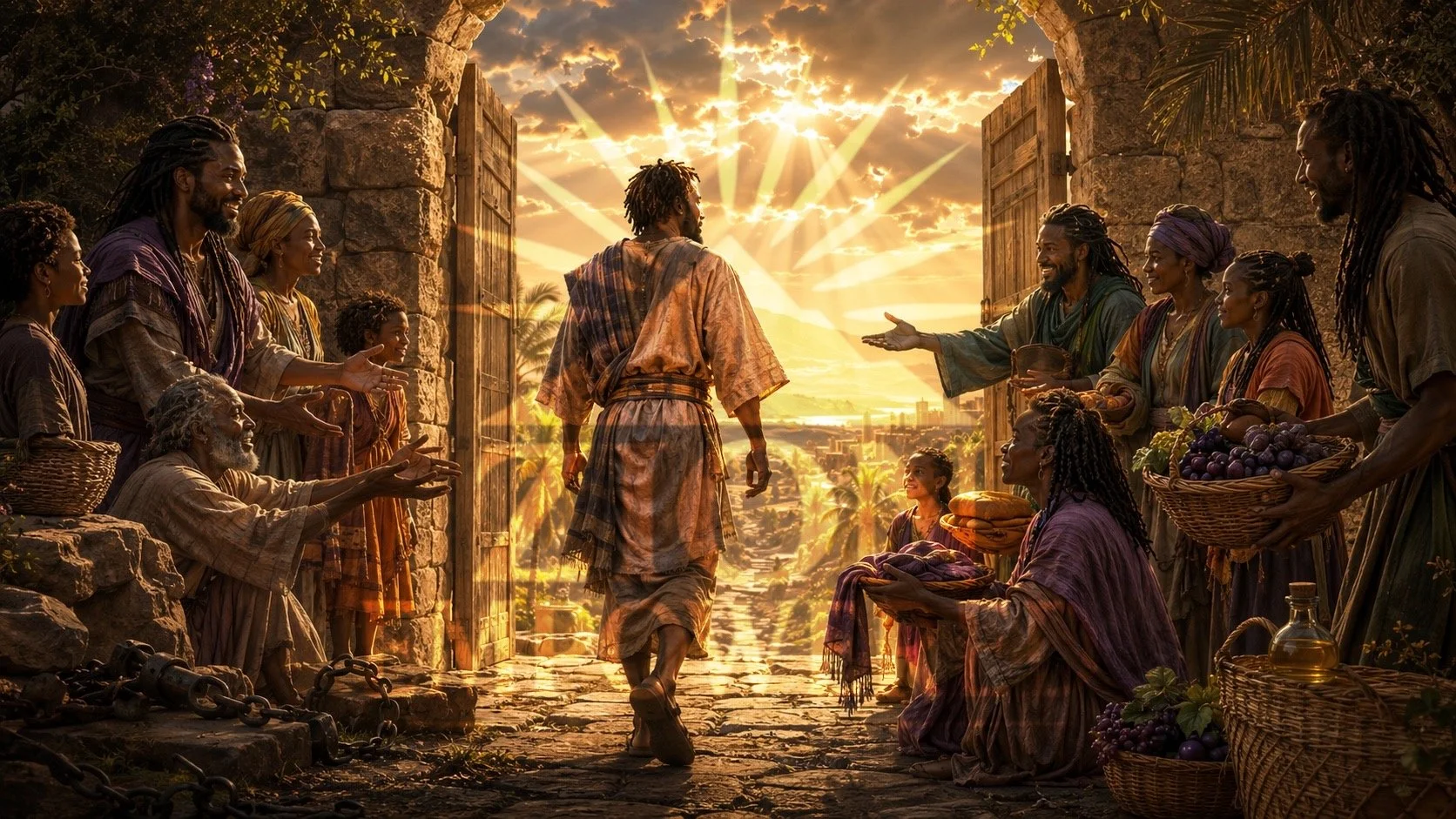
More than a Clean Slate
Preamble:
There is a certain feeling when summer begins turning toward fall.
School supplies appear.
Teachers prepare classrooms.
Families count down the last open weeks.
At the same time, another season begins.
Signs appear.
Commercials return.
Candidates make promises.
Everybody starts telling us what needs to be fixed.
Both seasons ask the same question:
What does it take to begin again?
We often imagine a new beginning as a clean slate.
The chains are gone.
The debt is canceled.
The door is open.
But Torah asks a harder question:
What is in their hand when they walk out?
Because an open door does not necessarily create a future.
A student can enter a classroom and still lack what they need to learn.
A community can hear promises of opportunity while people still lack the means to reach it.
A person can be released from yesterday and still have nothing with which to build tomorrow.
That is where Re’eh takes us.
Moses says:
Do not harden your heart.
Do not close your hand.
Open it.
Then comes the seventh year. The servant goes free.
But Torah does not stop at freedom:
“When you send him forth free from you, you must not send him forth empty-handed.”
Give from your flock.
Give from your threshing floor.
Give from your vat.
Then comes the reason:
Remember Egypt.
Remember what it meant to have your future controlled by somebody else.
Memory, in Torah, is not nostalgia.
Memory is supposed to change what our hands do.
That may be worth remembering as school doors open and political voices grow louder.
Because every promise eventually has to answer one practical question:
What did we actually place in somebody’s hand?
Then Paul says God was reconciling the world, “not counting their trespasses against them.”
The old account is interrupted.
The ledger does not get the final word.
And those who have experienced reconciliation are entrusted with its ministry.
So Re’eh asks something deeper than whether we believe in second chances:
When somebody receives a clean slate, have we also helped make the next chapter possible?
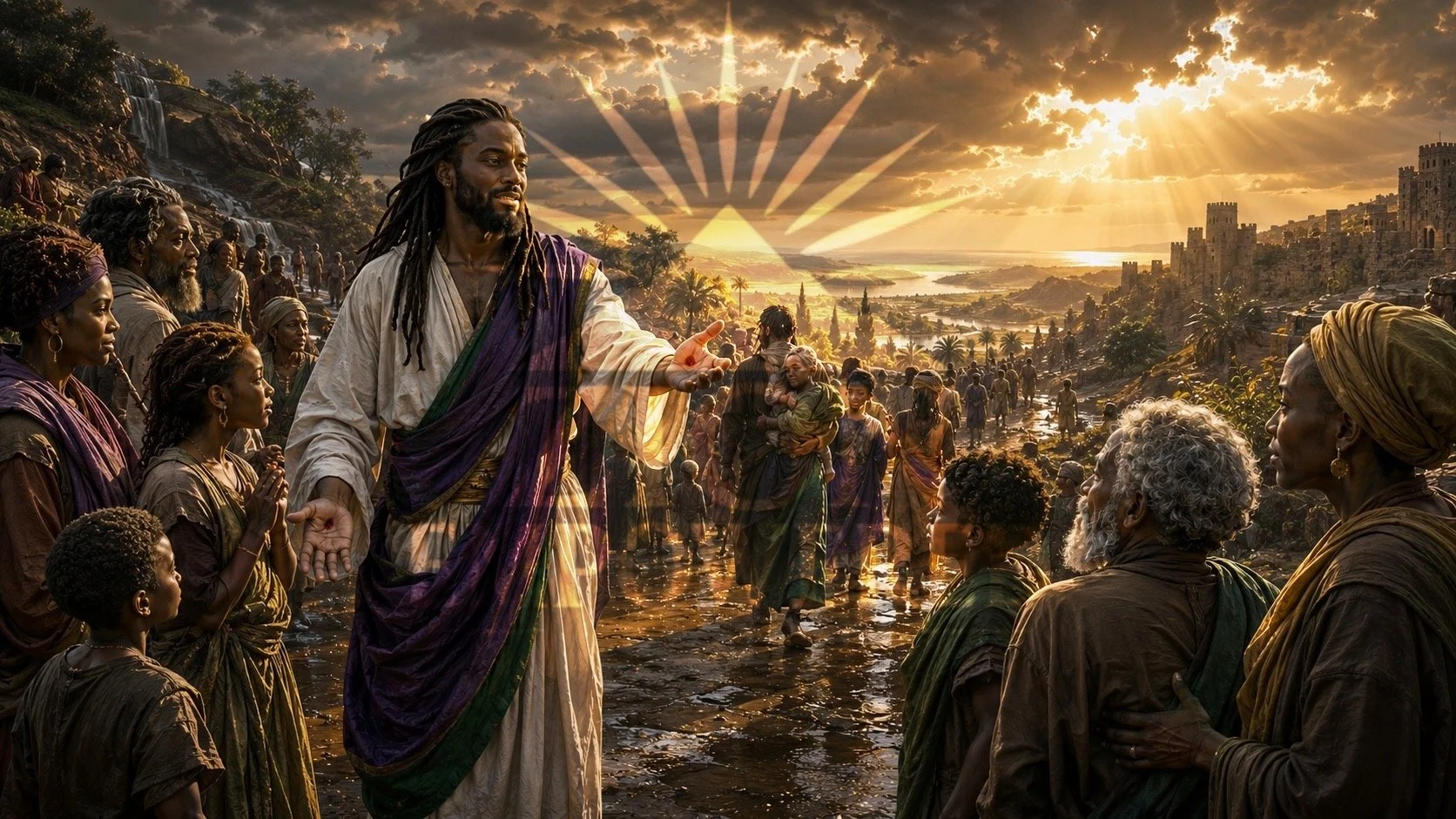
The Hands that Remember
Last Sunday taught us that the cloud still knows the way. Israel had been carried by fire at night and cloud by day, yet fear still caused them to misunderstand where God was leading them. This week, after so many gray days, the forecast said the rain would return. But grace kept opening the sky. One bright day became another, until we were given a whole week of light. Wonder begins when we stop treating mercy like it is ordinary.
Some moments carry that kind of grace. What begins quietly can become a promise, and what once felt small can grow strong enough to carry a life.
Seasons change. Hands age. But love is revealed by what it refuses to forget.
Forgetting comes easily. Old names return to microphones. Old arguments are dragged back into the light. Blame is rehearsed, fear is repackaged, and people speak as though we were never afraid, never isolated, never uncertain behind locked doors.
We remember the politics, but forget the trembling. We remember what side we were on, but forget the people we lost and the silence of a world that suddenly stopped.
Thomas also stands behind a locked door. He does not ask for another argument. He asks to see the wound. Zion looks at her ruined walls and believes God has forgotten her. But God does not deny the ruin. God says, “I have written you on the palms of My hands.”
The walls are remembered. The wounds are remembered. The frightened are remembered.
Moses warns Israel about another kind of forgetting.
When the wilderness is behind them, the houses are built, the tables are full, and their hands have become strong, they may begin taking credit for what grace made possible. They may remember what they built, but forget who gave them strength.
That may be the danger in every good season. Not that the blessing disappears, but that it becomes ordinary. We can stand beneath an open sky and stop looking up. We can hold the hand we once prayed to find and forget that love is still a wonder. We can survive the locked room and later speak as though we were never afraid.
So this week, the cloud moves into the hands. The God who guided Israel through uncertainty now teaches them how to remember in abundance. The Messiah who enters the locked room still carries the wounds. The God who hears Zion’s cry still carries her ruined walls upon divine palms.
The question is not only whether we remember God. The question is whether we can still recognize the wonder in the blessings, wounds, vows, and ruins that carried us this far.
The cloud still knows the way, and the hands still remember the story.
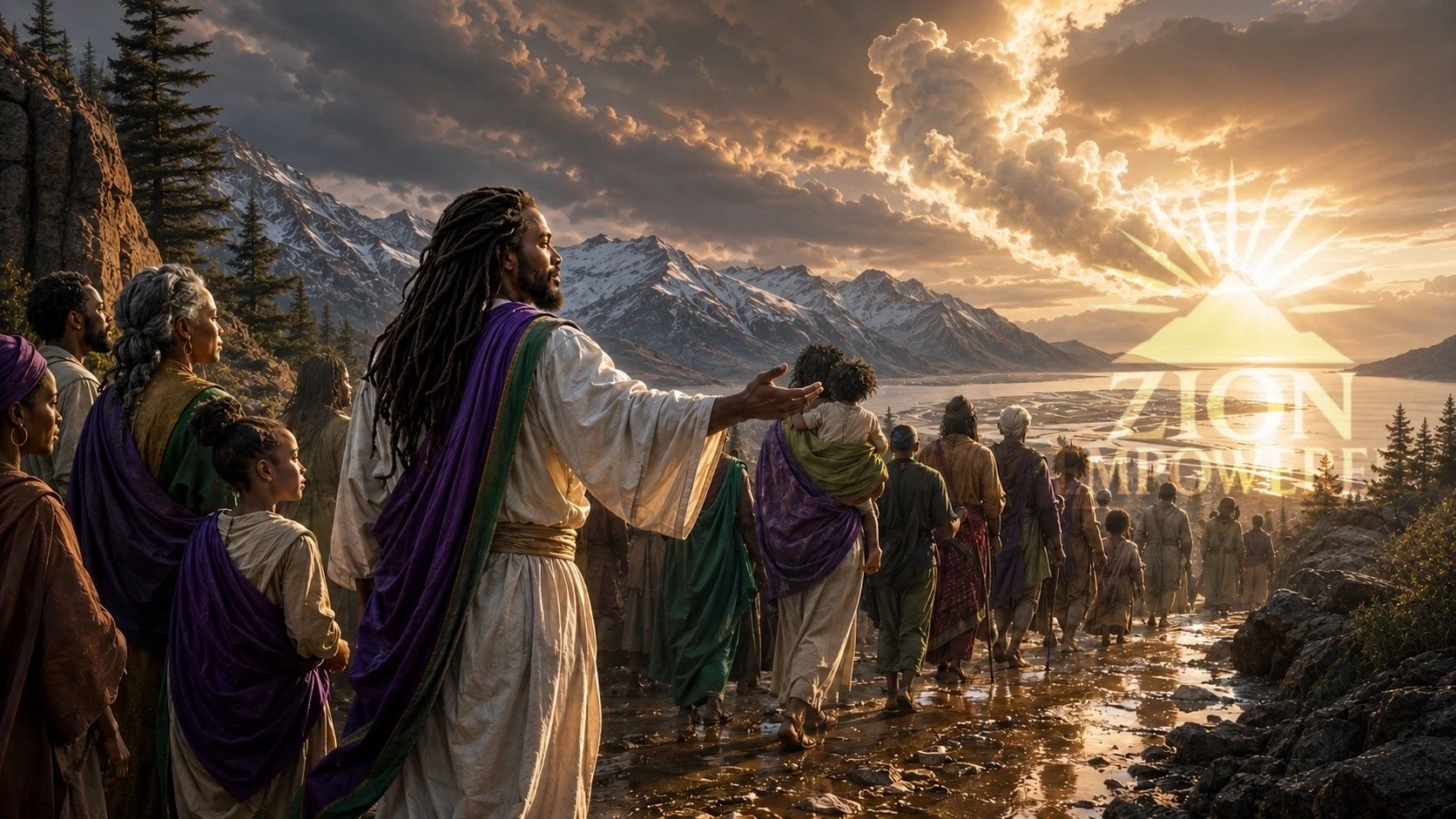
The cloud still knows the way
For much of July, Anchorage has lived beneath rain. The ground stayed wet. The clouds hung low. Even summer sometimes felt hidden from us.
Then the sun broke through.
We stepped outside, lifted our faces, and remembered how quickly ordinary light can become a gift when we have gone without seeing it.
The sun did not become new.
We became newly awake to it.
Perhaps that is how wonder returns. Not because God suddenly places something new before us, but because grace opens our eyes to what has been there all along.
Sunday is expected to remain bright, though the clouds are beginning to gather again for the week ahead. The sky changes its expression, but it does not stop bearing witness to the One who made it.
Sunlight awakens gratitude.
Rain teaches patience.
And sometimes even a cloud becomes mercy.
Last week, Scripture taught us that the road must say, “Refuge is this way.”
This week, Torah teaches us that even the cloud can say:
“This way.”
We often live as though sunshine proves God is near and clouds prove something has gone wrong. But Israel was not led by open skies. They were led by fire at night and cloud by day.
The cloud did not show them everything.
It showed them enough to obey.
The cloud did not hide the road. The cloud was how God revealed the road.
That is the holy mystery in the text. What looked like concealment was also guidance. What covered the heavens was the very thing God used to move the people forward.
John brings us to the same mystery.
The disciples are watching their own sky grow dark. Messiah speaks of departure, betrayal, death, and a place they cannot yet see. Thomas asks for directions, but Messiah gives him something deeper than a map:
“I am the way.”
Faith is not perfect visibility.
Faith is learning to walk behind the Presence, trusting that mystery is not the same as absence.
These passages do not promise us a cloudless life. They promise that God will go before us, fight for us, carry us when the road becomes too heavy, prepare a place for us, and remain the Way when we cannot see the way.
The sun may appear.
The clouds may return.
The road may turn.
But the God who goes before us does not change.
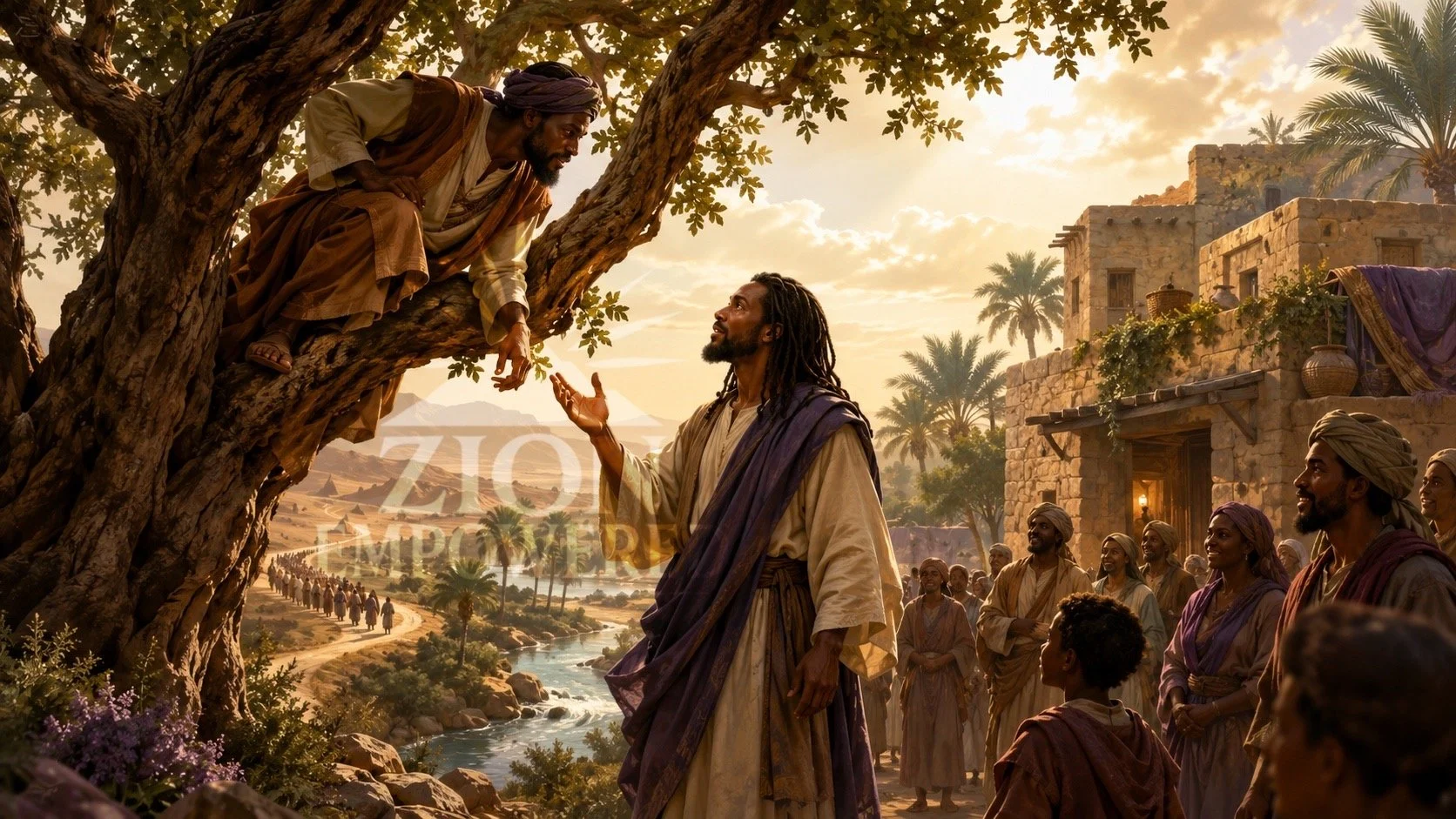
When Salvation Stops
Parashat Masei begins with what appears to be a list of places.
Rameses.
Sukot.
Eitam.
Pi HaChirot.
Marah.
Eilim.
At first glance, it reads like an itinerary. A record of where Israel stopped, where they rested, and where they gathered themselves enough to move again.
But Torah is practicing the sacred art of noticing.
It notices the departure as carefully as the arrival. It remembers where freedom began, where fear returned, where the waters opened, where the waters became bitter, and where shade and abundance finally appeared.
Nothing is removed from the sacred map.
Not the triumph.
Not the trembling.
Not the thirst.
Not even the place where they nearly forgot who they were.
Western thinking is usually more concerned with destination than formation. We ask where a person arrived, what they accomplished, how long they worked, what they built, and whether the world called them successful. We speak easily about what comes next, but often lack the courage to account for the road that brought us there.
Torah does not permit that kind of forgetfulness.
When retirement comes, it is not simply the end of work. It is the naming of a road traveled, burdens carried, sacrifices made, and years given that cannot be gathered back into the hand.
When a child celebrates another birthday, we are not merely counting years. We are standing before the mystery of a life still unfolding. We look at the child we once carried and the person now emerging, and we realize that time has been moving even when we were too busy to notice.
A birthday is a station.
Retirement is a station.
A decision that changes the direction of a life is a station.
Some choices announce themselves with thunder. Others arrive quietly, sit beside us, and alter the road forever.
A life-changing decision is rarely born in one moment. It is usually the gathering of many places: the room where we first became restless, the season when something no longer fit, the bitter place we survived, the voice we could no longer ignore, and the moment we became honest enough to move.
Moses is commanded to record Israel’s departures and journeys. Liberation is recorded. Fear is recorded. The sea is recorded. Bitter water is recorded. Shade and abundance are recorded.
The splendor is not merely in reaching Canaan. It is in noticing that God was present at every station.
God was not only waiting in Canaan.
God was in the leaving.
God was in the uncertainty.
God was at the sea.
God was at Marah.
God was beneath the palms of Eilim.
Perhaps one of the great tragedies of life is not that God was absent, but that we moved too quickly to notice where God had been standing.
Luke begins with similar language:
“He entered Jericho and was passing through it.”
Jericho appears to be another place along the road. Messiah is traveling toward Jerusalem, and the crowd expects him to keep moving.
But there is a man in a tree.
A man whose name is known, but whose humanity has been buried beneath his occupation, his wealth, his reputation, and his wrongdoing.
The crowd has reduced him to the worst thing it knows about him.
That is one of the cruelest habits of human beings. We demand the freedom to become more than our failures while denying that same freedom to somebody else.
Everyone sees Zacchaeus.
Few truly notice him.
They see a tax collector.
They see a collaborator.
They see a sinner.
Messiah sees a son of Abraham.
Everyone else sees a man to pass by.
Messiah stops.
He is passing through Jericho, but when he reaches Zacchaeus, the journey changes direction.
“I must stay at your house today.”
The house of a tax collector becomes a sacred station.
The crowd calls it scandal.
Heaven calls it salvation.
Masei teaches that every station matters.
Luke reveals that sometimes a person is the station.
Wisdom begins when we slow down long enough to notice who has been standing beside the road, waiting for someone to call them by name.
~ R. Avi N
Do what your love has promised
Preamble:
There are moments when God asks us to say what we believe.
There are other moments when God asks us to live what we have said.
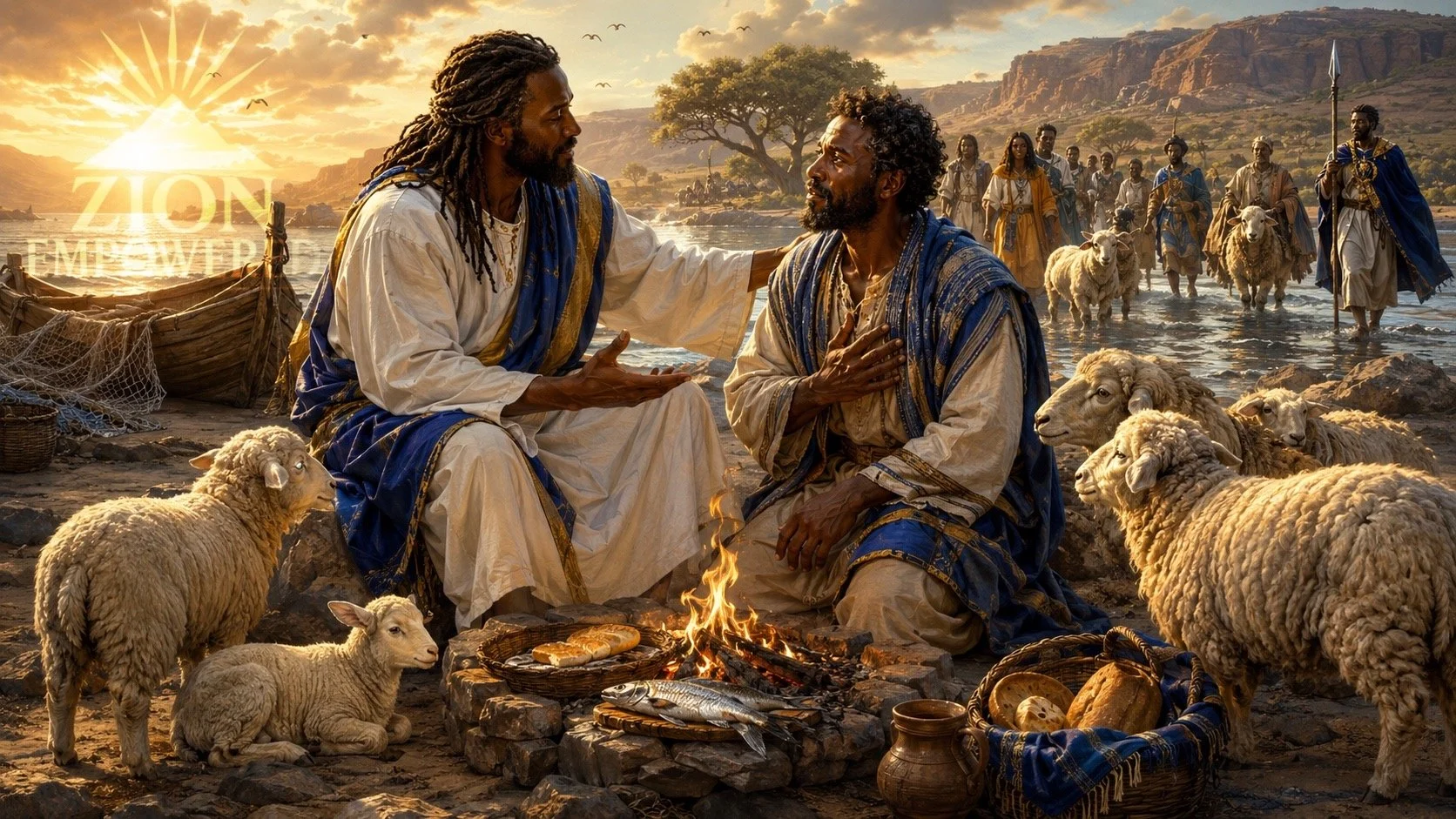
Peter is sitting beside a charcoal fire, eating breakfast with the One he denied. The tomb is empty. Messiah is risen. Grace has already found Peter on the shoreline. Yet resurrection does not erase the unfinished tension between Peter’s confession and Peter’s conduct.
Peter once said that even if everyone else fell away, he would remain.
Then pressure entered the courtyard.
A servant recognized him.
Fear tightened around him.
And the man who had spoken with such confidence denied Messiah three times.
Now, beside another charcoal fire,
Messiah asks him three times:
“Do you love Me?”
Peter answers:
“Lord, You know that I love You.”
But Messiah will not allow love to remain only an answer.
“Feed My lambs.”
“Tend My sheep.”
“Feed My sheep.”
That is where Matot enters the conversation.
Matot begins with the weight of speech.
A person must not profane his word. What comes out of the mouth must be fulfilled.
Then, near the end of the portion, Reuben and Gad stand before Moses. They have found land east of the Jordan that suits their livestock.
The land is good.
Their request is understandable.
Their inheritance appears to be within reach.
But the rest of Israel has not yet crossed over.
The rest of Israel has not yet received its inheritance.
Moses asks them a hard question:
“Should your brothers go to war while you sit here?”
In other words:
Will you settle into comfort while the community is still struggling?
Will you build your sheepfolds while your brothers and sisters remain without their place?
Will your blessing become an excuse to withdraw from somebody else’s burden?
Reuben and Gad answer:
“We will not return to our homes until all the Israelites have obtained their inheritance.”
Moses accepts their word, but he puts the obligation plainly before them:
“Do what you have promised.”
That is the hidden thread joining these texts.
Peter says:
“I love You.”
Messiah says:
“Then feed what I love.”
Reuben and Gad say:
“We will cross over.”
Moses says:
“Then do what you have said.”
Both passages ask whether speech will become service.
Both passages ask whether blessing will become responsibility.
Both passages ask whether a person can enjoy restoration, land, security, or calling without becoming accountable for the well-being of others.
Peter cannot remain beside the breakfast fire enjoying private forgiveness while the sheep remain hungry.
Reuben and Gad cannot remain beside their sheepfolds enjoying private inheritance while the community remains on the other side of the river.
The central truth is this:
Grace does not restore us merely so we can feel whole. Grace restores us so we can become responsible for someone else’s wholeness.
The Word That Heals the House
Preamble:
This week, with the sound of Independence Day still close enough to hear, the question is not simply, “Who has authority?”
That is usually the world’s question. Who is in charge? Who gives the orders? Who gets obeyed? Who has the rank, the title, the office, the badge, the pulpit, the uniform, the flag, or the seat?
And in a nation now standing near the weight of 250 years, we know that authority is never a small question. Freedom has always had to wrestle with power. Liberty has always had to ask what kind of authority it will answer to. A people can declare independence from kings and still have to learn dependence on righteousness, justice, mercy, and God.
Scripture presses us there.
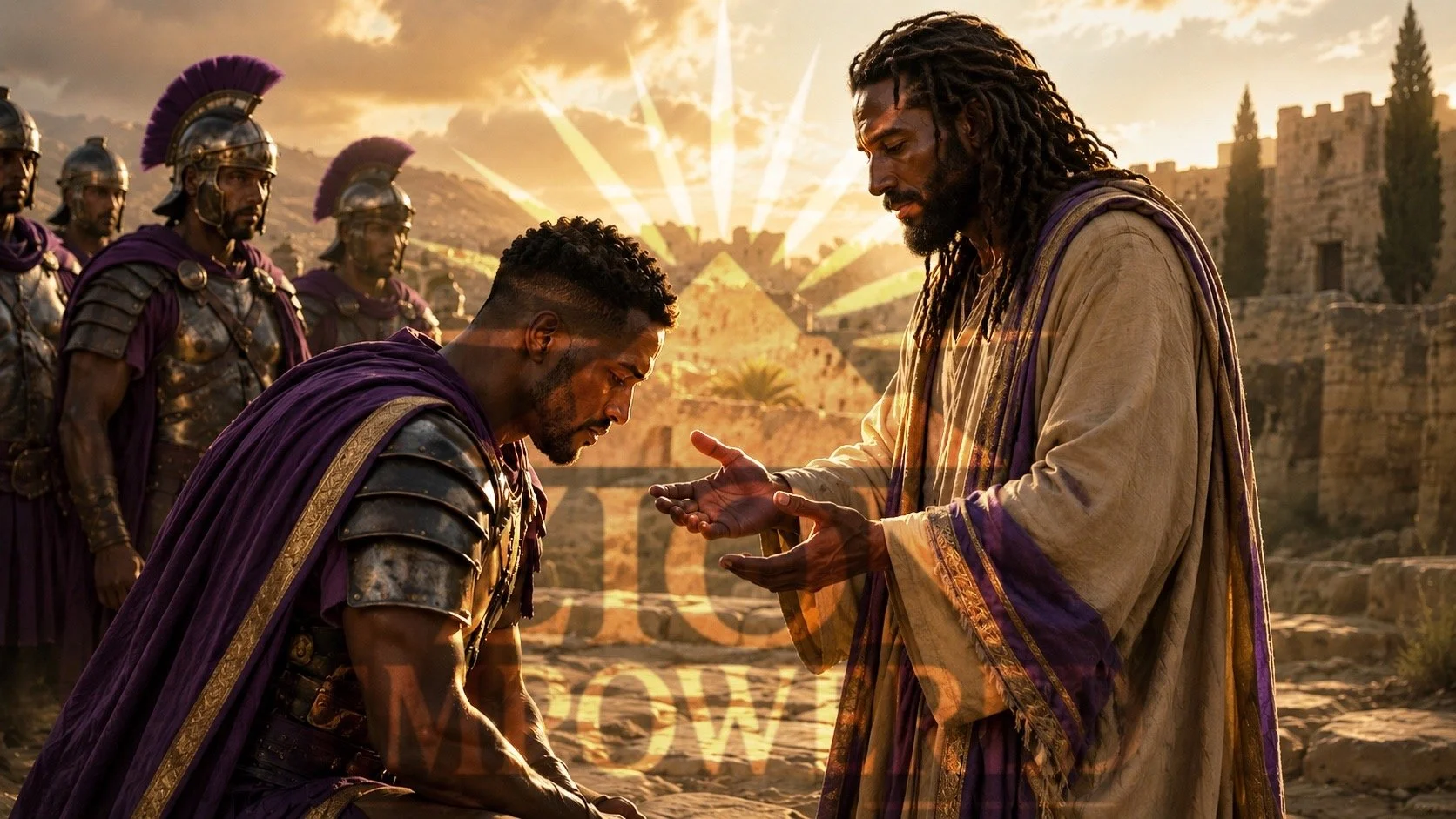
Matthew gives us a centurion, a man who knows how authority works. He has soldiers under him. He can say, “Go,” and they go. He can say, “Come,” and they come. Yet when he comes before Messiah, he does not come standing on rank. He comes bowing in faith. He says, “I also am a man under authority.”
That word under changes the whole lesson.
The centurion is powerful, but he is not free from accountability. He commands others, but he knows he is still commanded. He carries authority, but he does not worship it. And because his authority bows, healing can reach his house.
Then Pinchas gives us Moses near the end of his journey. Moses has carried people through wilderness, complaint, rebellion, grief, hunger, thirst, fire, plague, and disappointment. But when he learns his season is closing, he does not first ask God to protect his legacy. He asks God to protect the people.
He says, “Let the Lord, the God of the spirits of all flesh, appoint someone over the congregation.”
That is the hidden jewel.
Moses does not say, “Give them a manager.”
He does not say, “Give them a general.”
He does not say, “Give them somebody who can keep everybody in line.”
He says, in effect:
“Lord, You know every spirit.
You know every temperament.
You know every wound.
You know every fear.
You know every stubborn place and every tender place.
Give them somebody who can shepherd what only You fully understand.”
The old rabbis saw this. Rashi says Moses is asking for a leader who can bear with each person according to that person’s own mind, because no two people are alike. Bamidbar Rabbah says that just as human faces are not all the same, human dispositions are not all the same.
That is a word for any house, any church, any union, any family, and any nation that wants freedom without losing its soul.
So this Sunday, we are not just studying authority.
We are studying the God of the spirits and the Word that heals.
Authority that bows.
Authority that heals.
Authority that transfers.
Authority that shepherds.
Authority that knows people are not just bodies in seats, names on a list, members in a church, workers on a schedule, citizens in a count, or numbers in a census.
They are spirits before God.
And the measure of holy authority is not how loudly it commands, but whether it can bring the wounded safely home.
The Hired Prophet and the Good Shepherd
Preamble:
This week, the question is not only, “Can God stop a curse?”
We already know God can do that.
The deeper question is:
Who gets to name the people of God?
Who gets to speak over the flock?
Who gets to interpret the presence of a blessed people in the world?
Balak looks at Israel and sees a threat.
God looks at Israel and sees a blessing.
Balak sees a people too numerous.
God sees a people already named.
Balak wants to hire a prophet to curse them.
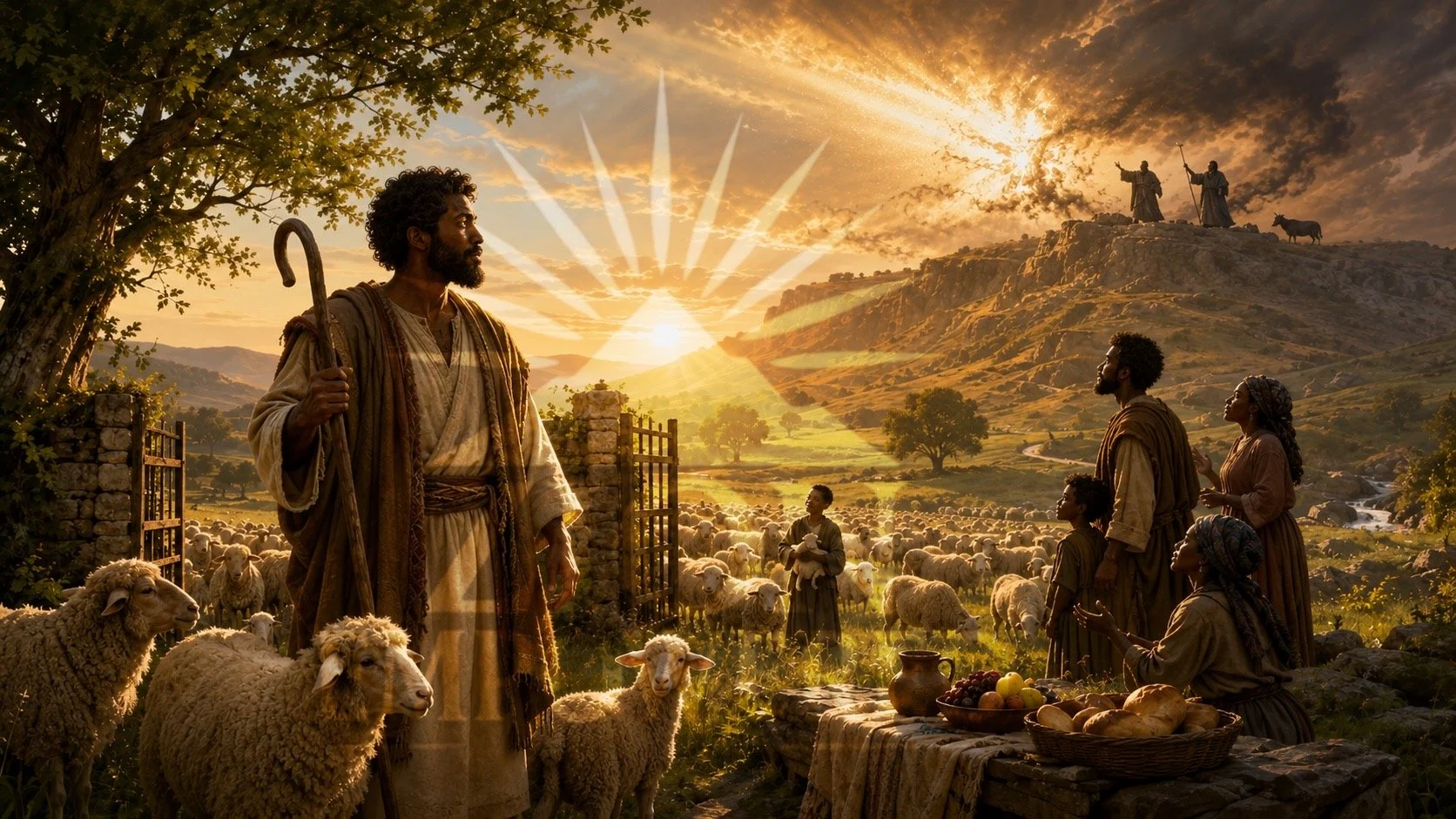
Messiah says, “I am the good shepherd.”
That is the tension of this lesson.
There are weeks when many meanings stand in the room at once. A birthday can quietly remind us that life itself is a blessing. A field in Palmer can remind us that strength is not only noise, but discipline, balance, timing, and courage. A state can be talking again about gaslines, energy, work, and what ought to flow into the life of Alaska.
And Scripture comes asking:
when something powerful is moving through the land, will we call it danger, or will we ask what God is doing?
Balak sees movement and calls it a problem.
He sees a people coming out of Egypt, still carrying wilderness dust, still learning how to walk free, and he decides they must be cursed before they get too close.
That is how fear works.
Fear sees before it understands.
Fear speaks before it listens.
Fear hires religion to sanctify what panic has already decided.
Balak is afraid before Israel says a word to him.
Balak is sick before Israel touches him.
Balak has already made up his mind before he sends for Balaam.
And that spirit still walks around. It shows up whenever growth is treated like invasion, survival is called disorder, and a people standing upright is interpreted as a threat.
But Scripture slows us down.
Not every large thing is dangerous.
Not every strong thing is violent.
Not every people moving forward should be feared.
Sometimes what looks like disruption is deliverance still in motion. Sometimes what looks like a burden is a blessing still unfolding. Sometimes what looks like a threat to fearful power is really a flock under the eye of the Shepherd.
And then comes John.
Messiah says, “The thief comes only to steal and kill and destroy.” But He also says,
“I came that they may have life, and have it abundantly.”
So this Sunday, we stand between Balak and the Shepherd.
Balak hires a mouth.
Messiah lays down His life.
Balak wants the people cursed and driven away.
Messiah gathers the sheep and gives them pasture.
Balak speaks from fear.
Messiah speaks from love.
Balak sees Israel as something to control.
Messiah sees the sheep as His own.
And God says over Israel, before they are perfect, before they have arrived, before they have learned every lesson:
“You must not curse the people, because they are blessed.”
That is the mercy holding the people before they even know they are being discussed.
There are conversations happening on mountains Israel never heard. There are arrangements being made against them that they did not attend. But God enters the conversation before the curse can land.
And that is good news.
The Shepherd knows what the sheep do not know.
The Shepherd hears what the sheep do not hear.
The Shepherd sees the wolf before the flock understands the danger.
So today we ask: whose voice will name us?
Will fear name us?
Will power name us?
Will money name us?
Will anxiety name us?
Will the hired mouth name us?
Or will the Good Shepherd name us?
Because the thief comes to steal, kill, and destroy.
But the Shepherd has come that we may have life.
Not just life barely surviving.
Not just life limping through the wilderness.
Not just life waiting for the next curse to fail.
Abundant life.
Life under the right voice.
Life under holy care.
Life where strength is disciplined, blessing is guarded, and the people of God learn to walk as those whom heaven has already called blessed.

Speak to the Rock
This week, the question is not only, “Can God bring water from the rock?”
We know God can do that.
The deeper question is:
Can God bring tenderness out of a wounded leader?
Can God bring justice out of a worshiping people?
Can God bring life out of a community that has been too close to death?
There are weeks when several meanings arrive at once.
A day can carry memory, fatherhood, longer light, a city’s long-awaited joy, and even the quiet weight of a new mantle.
Not everything has to be announced loudly to be holy.
Some things simply stand in the room with us.
Numbers begins quietly but heavily:
Miriam died and was buried.
Then the very next line says:
There was no water.
That is not just geography.
That is theology.
The people are thirsty, but the text has already shown us something deeper.
Something has died in the camp.
Miriam is gone.
The sister who watched Moses float down the Nile is gone.
The prophet who sang at the sea is gone.
The woman whose voice helped carry liberation is gone.
And before anyone can process the grief, the people start arguing about water.
That feels familiar.
Many communities do not know how to mourn, so they fight.
Many families do not know how to name grief, so they complain.
Many leaders do not know how tired they are until one more crisis breaks the surface.
The people say, “There is no water.”
But under that sentence, another truth is flowing:
We are scared.
We are tired.
We are grieving.
We do not know if we can survive this wilderness anymore.
And still, God does not abandon them.
God does not tell Moses to perform anger.
God does not tell him to turn pain into force.
God says:
Take the staff.
Gather the people.
Speak to the rock.
That command carries water.
There are seasons when you carry authority, but God asks for restraint.
There are seasons when the staff is in your hand, but the miracle is in your mouth.
There are seasons when people need water, but God is also watching how the water is given.
Then Amos steps in with the prophetic edge.
He says worship can be loud and still be dry.
Songs can be correct and still be hollow.
Assemblies can be full and still be unjust.
God says, in effect:
Do not give Me noise while people are thirsty.
Do not give Me offerings while righteousness is missing.
Do not give Me religion that does not become water.
So Numbers and Amos meet each other.
Numbers says:
Speak to the rock, and water will come.
Amos says:
Let justice roll like water, or your worship is not clean.
Together they teach:
God does not only care that water comes.
God cares how water comes.
God cares whether the wounded are handled with holiness.
God cares whether worship becomes justice.
God cares whether leaders speak life or strike from pain.
Because the longest light is still not enough if the people remain dry.
A victory is still incomplete if the wounded are forgotten.
A title is only holy if it makes the servant more gentle.
And fatherhood, leadership, ministry, and worship all meet at the same question:
Can you carry strength without striking the rock?
The Staff and the Vine
Preamble:
Before Messiah speaks about fruit, Torah shows us a staff.
Not a tree.
Not a vine.
Not something planted beside a river.
A staff.
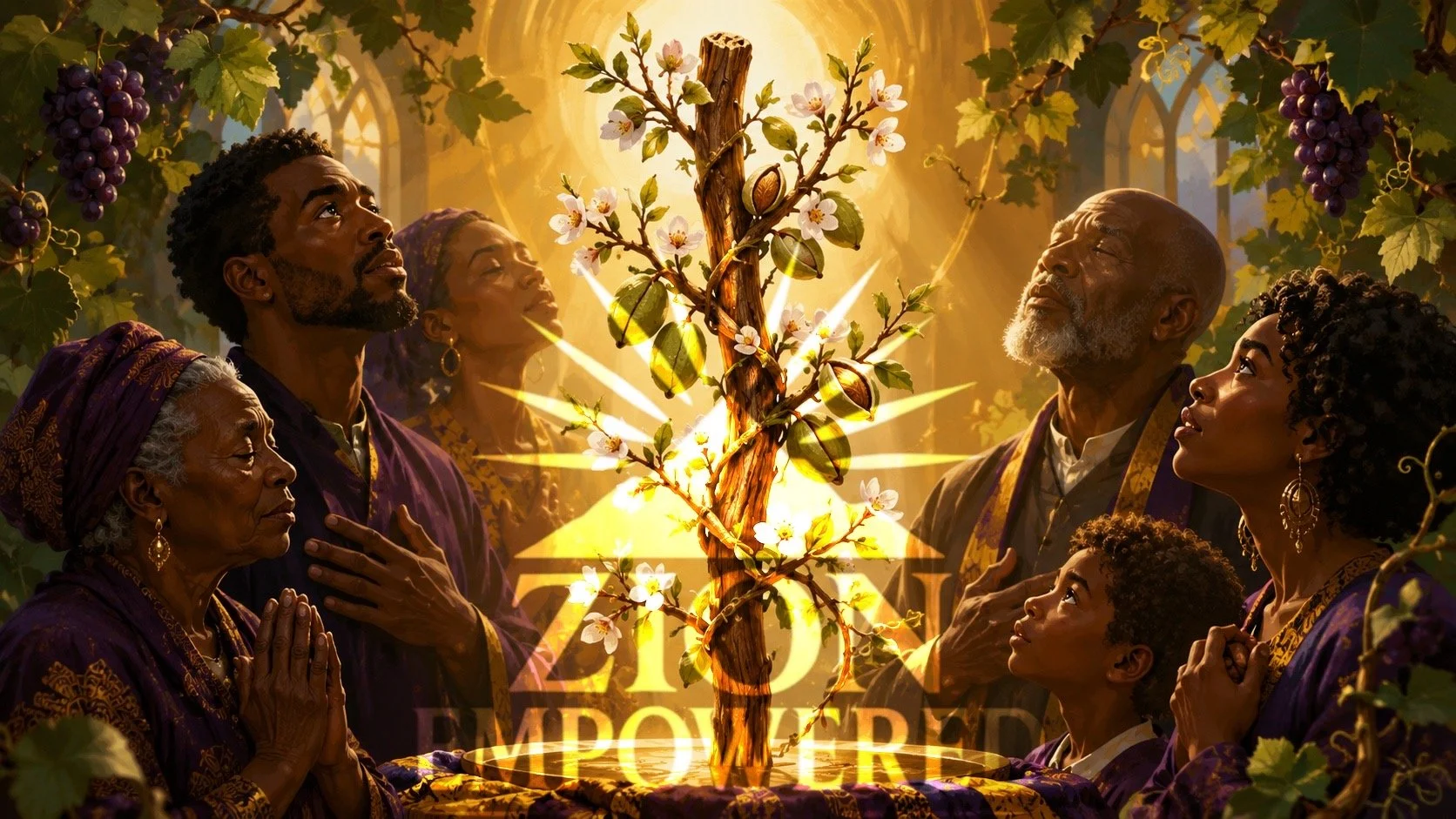
A staff is wood that has already been cut. It has history, but no roots. It has shape, but no sap. It can represent authority, but it cannot produce life by itself.
Yet God tells Moses to take the staffs of the tribes and place them before the Ark of the Testimony, in the place where God communes with His people. And by morning, Aaron’s staff has blossomed. It has buds. It has blossoms. It has ripe almonds.
That is not agriculture.
That is revelation.
Then Messiah says to the disciples, “You did not choose me. I chose you. I appointed you to go and produce lasting fruit.”
So the question of the lesson is not merely, “Who has the staff?”
The question is, “What is blooming from the staff?”
Because in the Kingdom of God, calling is not proven by noise.
Calling is not proven by position.
Calling is not proven by winning the room.
Calling is proven by love that remains, service that bears fruit, and a life that can still blossom after being placed in the presence of God.
GOD DOES NOT ONLY CHOOSE THE STAFF; GOD MAKES THE STAFF BLOOM.
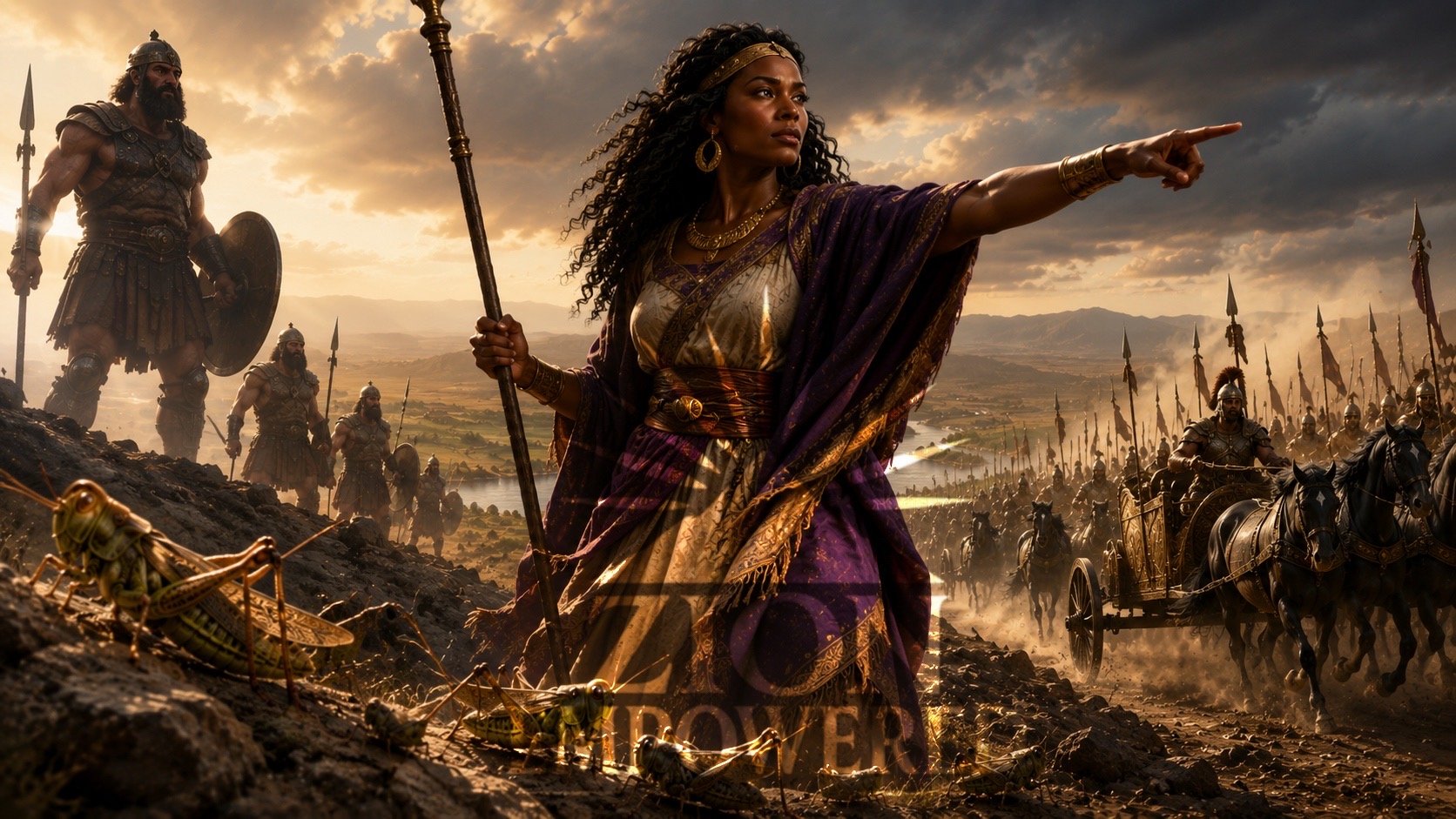
Grasshoppers and Iron Chariots
Preamble:
Before Israel enters the land, they must learn how to see.
Before Deborah enters the battle, she must teach others how to see.
The giants are real.
The chariots are real.
The danger is real.
Yet Scripture refuses to let visible realities become ultimate realities.
Numbers gives us a generation that sees giants and imagines itself as grasshoppers.
Judges gives us a generation that sees iron chariots and hears that the Lord is already marching ahead.
Both stories ask the same question:
Who gets to interpret what we see?
Because most people do not see reality as it is. They see reality through the habits, fears, memories, and expectations that shaped them.
The spies see a future, but they interpret it through Egypt.
Deborah sees a battlefield, but she interprets it through covenant.
That tension feels surprisingly familiar.
We live in a time when every headline arrives with an interpretation attached. Every crisis comes with a narrative. Every challenge is quickly declared either proof of collapse or proof of victory. We are surrounded by voices telling us what the facts mean before we have time to wrestle with them ourselves.
Yet Scripture slows us down.
The giants are real.
The chariots are real.
But neither story asks whether the obstacle exists.
The question is whether the obstacle becomes the dominant fact.
A few weeks ago, Knicks fans spent another season hearing what they have heard for years: the odds, the rankings, the predictions, the reasons it cannot happen. Some of those facts were true. Most were reasonable. Yet every game still had to be played. Because statistics can describe a situation, but they cannot fully determine a future.
Joshua and Caleb understood that.
Deborah understood that.
The obstacle may be real, but the obstacle is never the whole story.
Because freedom is not only leaving Egypt.
Freedom is learning not to think like Egypt after you leave.
The Spirit in the Camp
Preamble:
Before the Spirit moves through the camp, God lets Moses feel the weight of carrying too much alone.
That is the quiet ache inside Numbers 11. Moses is not weak. Moses is not faithless. Moses is not quitting because he lacks calling. Moses is telling the truth about the human frame. No one person was created to carry the hunger, grief, complaints, wounds, fears, and expectations of an entire people by themselves.
And that sounds a lot like now.
We are living in a season where the needs keep multiplying. Groceries cost more. Families are stretched thin. Elders and widows are lonelier than many will say out loud. Churches, teachers, caregivers, workers, unions, nonprofits, and everyday helpers are being asked to hold more with less. People are carrying private grief in public places, smiling in grocery lines, answering messages with tired souls, and trying to look composed while the burden underneath is bending their back.
Moses stands there before God like every overburdened servant. Every tired parent. Every pastor with too many names on the prayer list. Every caregiver who has not had time to grieve. Every worker who keeps showing up because somebody has to hold the line.
And Moses finally says what a lot of faithful people are scared to say:
“I cannot carry this alone.”
That is not failure. That is honesty.
Sometimes the most faithful thing a leader can do is stop pretending the weight is light. Because holy work can still get heavy. Sacred calling does not cancel human limits. You can be chosen and tired. You can be anointed and overwhelmed. You can love the people and still need help carrying them.
And God does not answer Moses by giving him a bigger personality, a louder voice, or a tighter grip on the people. God answers Moses by sharing the Spirit.
That is important.
God’s answer to communal pain is not one heroic leader becoming more heroic. God’s answer is shared burden. Distributed anointing. Holy responsibility spread through the body. The Spirit does not make Moses less. The Spirit makes the people more.
Seventy elders gather near the Tent of Meeting. The cloud descends. The Spirit rests on them. They prophesy.
But then the story turns.
Two men, Eldad and Meidad, remain in the camp. They are not standing at the expected place. They are not positioned where Joshua thinks they should be. Yet the Spirit rests on them too. And when news reaches Joshua, he says what anxious loyalty often says:
“Stop them.”
That is not just ancient. That is still the reflex of people and systems when God moves through someone they did not authorize, certify, platform, or predict.
But Moses answers with the generosity of a secure soul:
“Are you zealous for my sake? If only all God’s people were prophets.”
That is the thunder.
Because real spiritual leadership is not proven by how tightly it controls the center. Real spiritual leadership is proven by whether it can recognize God moving at the edge.
There is also a justice fire burning underneath this text. It will not let religious language become a hiding place from real responsibility. It is not enough for the sanctuary to say it loves the poor if the widows remain uncovered. It is not enough to sing about mercy if nobody can hold up evidence of our care. Faith has to become material. Grace has to become garment. Spirit has to become service.
Then Acts 9 shows us what prophecy in the camp can look like when it puts on flesh.
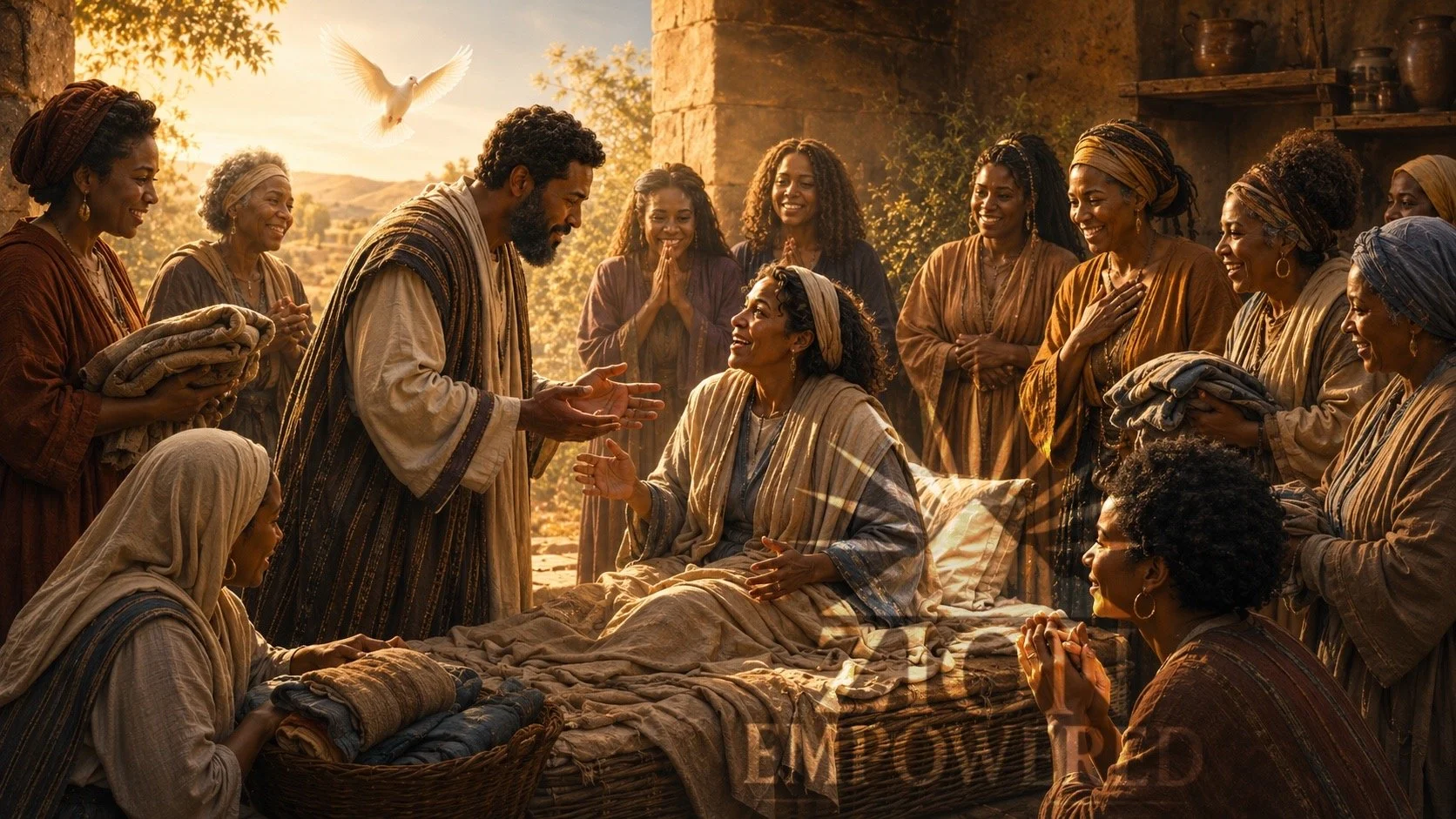
Tabitha is not introduced with a title. She is not called apostle, elder, bishop, prophet, or preacher. She is introduced by her mercy. She was always doing kind things and helping the poor.
When she dies, the widows do not bring a résumé. They bring garments.
They hold up the coats and clothes she made. They testify with fabric. They preach with evidence. They say, in their own way:
“This woman covered us.”
And that is where Acts and Numbers meet.
Eldad and Meidad prophesied in the camp.
Tabitha served in the camp.
Eldad and Meidad carried the Spirit through speech.
Tabitha carried the Spirit through care.
Some prophets speak what God is saying.
Some prophets show what God is like.
So this Sunday, we are not only asking, “Who has a title?”
We are asking, “Who is carrying the burden?”
We are not only asking, “Who is standing near the Tent?”
We are asking, “Who is faithful in the camp?”
We are not only asking, “Who has the microphone?”
We are asking, “Who is covering the widows?”
Because the Spirit does not only move through the spectacular. The Spirit moves through steady hands, quiet mercy, folded garments, hot meals, hospital visits, text messages, rides to appointments, prayers whispered in kitchens, and love so practical that people can hold it up when words fail.
In a time when many people are hungry for bread, hungry for connection, hungry for dignity, and hungry to know they have not been forgotten, Tabitha teaches us that care can become prophecy. Moses teaches us that leadership must make room for Spirit beyond its own control. And the camp teaches us that God is already moving in places the center has not yet learned how to honor.
The Blessing Was Made for the People
Preamble:
Before God gives Israel a blessing, God teaches Israel what blessing is for.
That is the quiet power inside Numbers. The priests are not told to impress the people, control the people, or burden the people. They are told to bless them.
May God bless you.
May God watch over you.
May God shine His face toward you.
May God give you grace.
May God lift His face toward you.
May God give you peace.
That is not soft religion. That is survival language.
Because a people moving through wilderness need more than rules. They need keeping. They need grace. They need peace. They need the face of God turned toward them when the road is long, the burden is heavy, and the future is not yet clear.
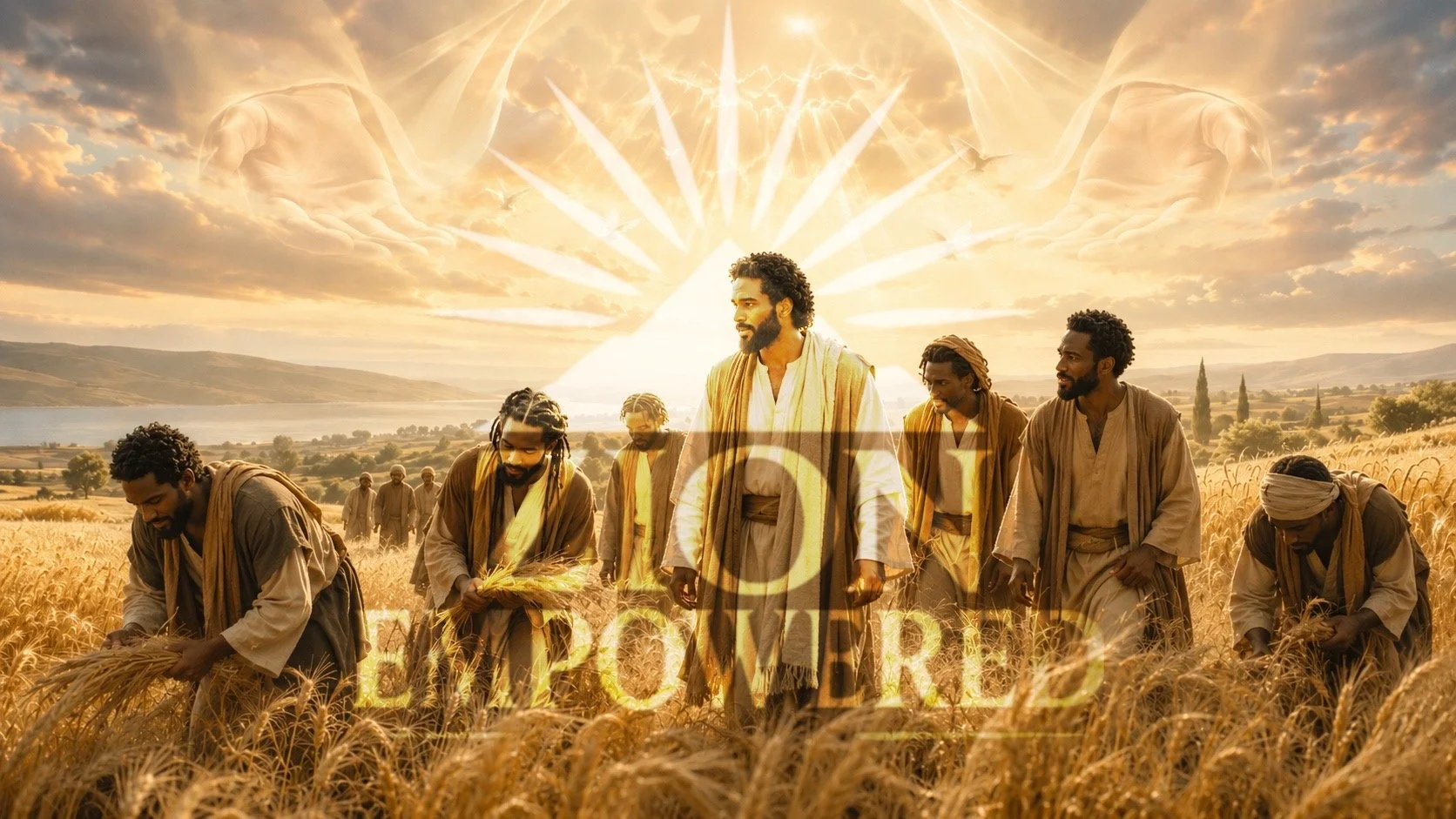
Then Mark brings us into a grainfield on the Sabbath. The disciples are hungry. The religious watchers see a violation. Jesus sees people. And with one sentence, He pulls Sabbath back from the hands of religious machinery:
“The Sabbath was made to meet the needs of people, and not people to meet the requirements of the Sabbath.”
That word lands with weight this weekend, as our nation pauses for Memorial Day. We remember that names matter. Bodies matter. Sacrifice matters. Families matter. Empty chairs matter. Peace is not cheap, and rest is not casual.
So this Sunday, we do not use memory to glorify war. We use memory to honor the cost of peace.
And that is where Mark and Numbers meet.
The Sabbath was made for people.
The blessing was spoken over people.
God’s Name was placed upon people.
So if God places His Name upon the people, then we cannot treat people like obstacles to holiness. The hungry matter. The tired matter. The grieving matter. The burdened matter. The ones carrying memory into this weekend matter.
Holiness was never meant to make people less human.
Holiness blesses.
Holiness keeps.
Holiness shines.
Holiness gives grace.
Holiness makes peace visible.
The Ones Not Counted Still Carry the Center
Preamble:
Before God lets Israel become powerful, God teaches Israel how not to become Pharaoh.
That is the quiet thunder inside Deuteronomy. Israel has land now. Israel has fields now. Israel has crops, wages, workers, courts, debts, garments, olives, grapes, and grain. In other words, Israel now has enough power to forget what pain taught them. So God says: remember Egypt. Remember what it felt like to live under somebody else’s economy. Remember what it felt like when your body was useful but your name was not honored. Remember what it felt like to build somebody else’s world while your own children waited for bread.
And maybe that word lands close to home this Sunday, even here in Anchorage, where women and girls of all ages will gather for a triathlon — moving through water, road, and running path, some racing, some volunteering, some cheering, all bearing witness in their own way. It is a living reminder that bodies are not machines, effort is not invisible, and strength is not always loud. Every person on the course is more than a number on a roster.
So when the worker needs wages before sunset, pay them.
When the foreigner needs justice, give it.
When the orphan stands in court, do not let the child stand alone.
When the widow has only one garment, do not turn her covering into collateral.
When the field has extra grain, do not harvest mercy out of the soil.
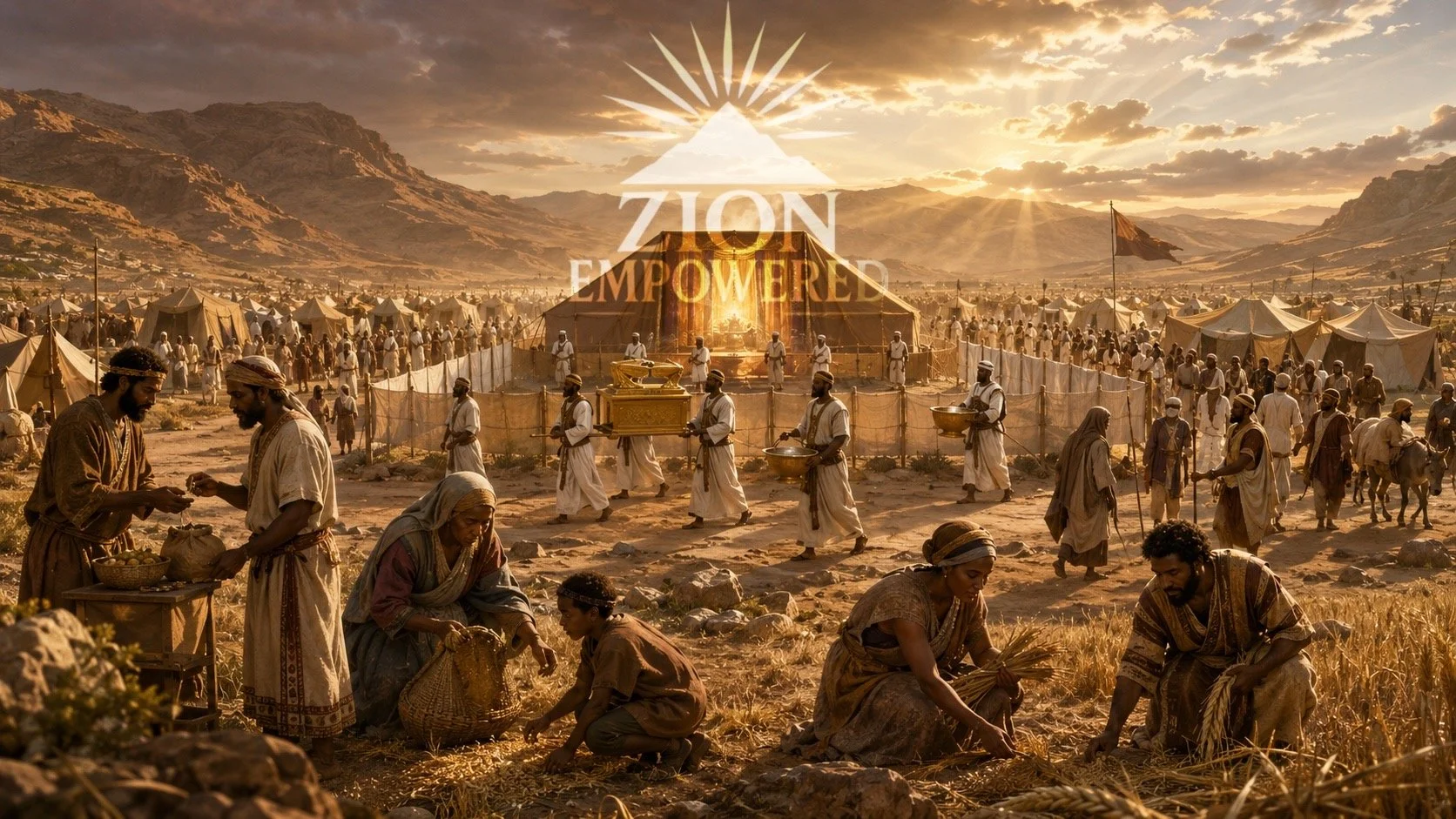
Then Numbers brings us into the wilderness and starts counting everybody.
Tribe by tribe.
House by house.
Name by name.
But suddenly the counting stops.
The Levites are not numbered with the rest. Not because they do not matter. Not because they are invisible. Not because God forgot them. They are not counted with the army because they are carrying something the army cannot carry.
They are carrying the center.
That is the word for this week:
Do not mistake public counting for divine value.
Do not mistake hidden labor for lesser labor.
Do not mistake the edge for emptiness.
Do not mistake the center for decoration.
God may be holding the whole community together through the people nobody thought to count. And the scandal of holiness is that God keeps noticing the worker, the widow, the stranger, the orphan, and the quiet Levite carrying the weight while everybody else is busy reading the numbers.
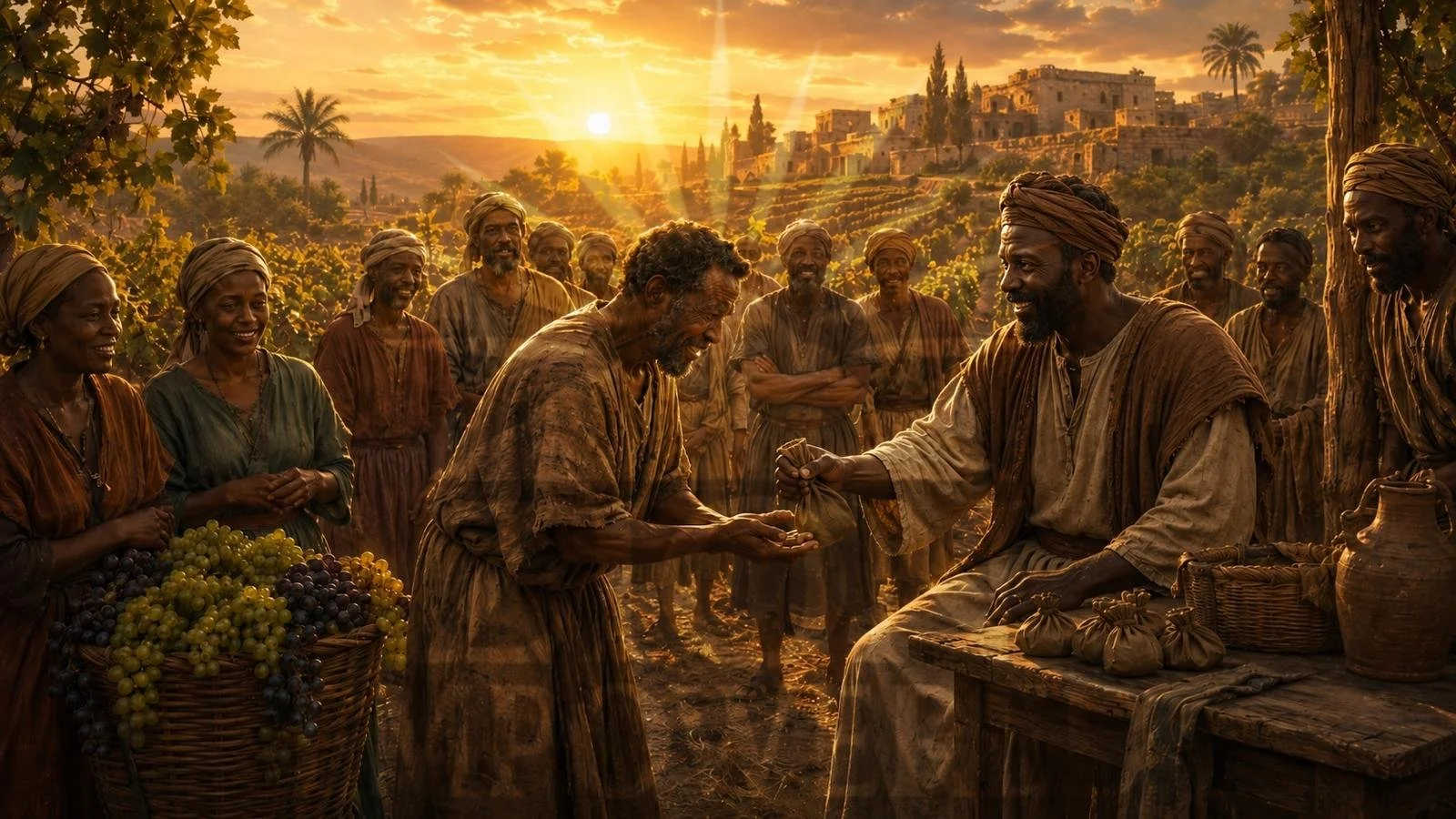
The Last Worker and the Corner of the Field
Opening Preamble
The Last Worker and the Corner of the Field
Before Jesus takes us into the vineyard, Scripture first takes us into the harvest field.
The lesson does not begin with an argument about pay. It begins with grain, worship, memory, and a command: when the harvest comes in, do not eat first. Remember first.
Leviticus tells Israel to bring the first bundle before the Lord. Lift it. Consecrate it. Count the days. Mark the season. Remember that the land was gift before it was labor, that the rain fell before the sickle swung, and that the seed carried mystery before the hand carried harvest.
Because the human heart is a strange thing. Let the field get full enough, and we start rewriting the story. We start acting as if blessing began with our effort, as if the field owes everything to our sweat and nothing to the mercy that woke us up able to work it.
But the sacred text will not let the harvest become arrogant.
Just when the worship feels finished, after the offering, after the counting, after the holy rhythm, God turns our eyes from the altar to the edge.
Do not harvest all the way to the corner.
Do not pick up every dropped piece.
Do not clean the field so well that the poor have nothing left.
Leave something for the poor.
Leave something for the stranger.
That is the holy interruption.
Worship is not complete when the offering is lifted. Worship is tested by what remains for somebody else. The field is not holy merely because grain came out of it. The field is holy when mercy is left in it.
Then Matthew brings us to a vineyard.
There are workers hired early, at nine, at noon, at three, and then there are workers still standing at five o’clock. Not because they refused the field. Their own words tell the truth:
“Because no one hired us.”
That sentence ought to slow us down.
We live in a time when people are quick to name somebody lazy, quick to question somebody’s worth, quick to build a whole story from half a fact. We know how to turn suspicion into speech. We know how to dress resentment up like discernment.
The old teachers called that danger lashon hara; harmful speech, words that may carry a piece of truth but do not carry love, justice, or necessity. Beside it stands the evil eye; not superstition, but a resentful way of seeing. An eye that looks at another person’s mercy and feels robbed.
That is what happens in the vineyard.
The first workers are not cheated. They receive what was promised. But when the last workers receive enough to live, the first workers become offended. Their problem is not injustice. Their problem is goodness given to somebody they ranked beneath themselves.
They saw hours.
The landowner saw households.
They saw “only one hour.”
The landowner saw somebody going home with bread.
And that is where the Gospel gets under our skin.
Some of us love grace when it rescues us. We question it when it feeds somebody we think came too late, worked too little, suffered too softly, or stood too long outside the field.
But the Kingdom does not run on scarcity, comparison, the evil eye, the loose tongue, or the small arithmetic of wounded pride.
The Kingdom runs on the goodness of the Landowner.
So Leviticus says: leave the edge.
Matthew says: do not resent the last worker.
The biblical witness says: the poor and the stranger must find bread in the field.
Jesus says: the one nobody hired still has a place in the vineyard.
And the question before us is not only:
What did we bring to God?
The question is also:
Who can still eat after we are done gathering?
Who did we judge before we understood their waiting?
And can our eyes be healed enough to rejoice when grace finds somebody else too?
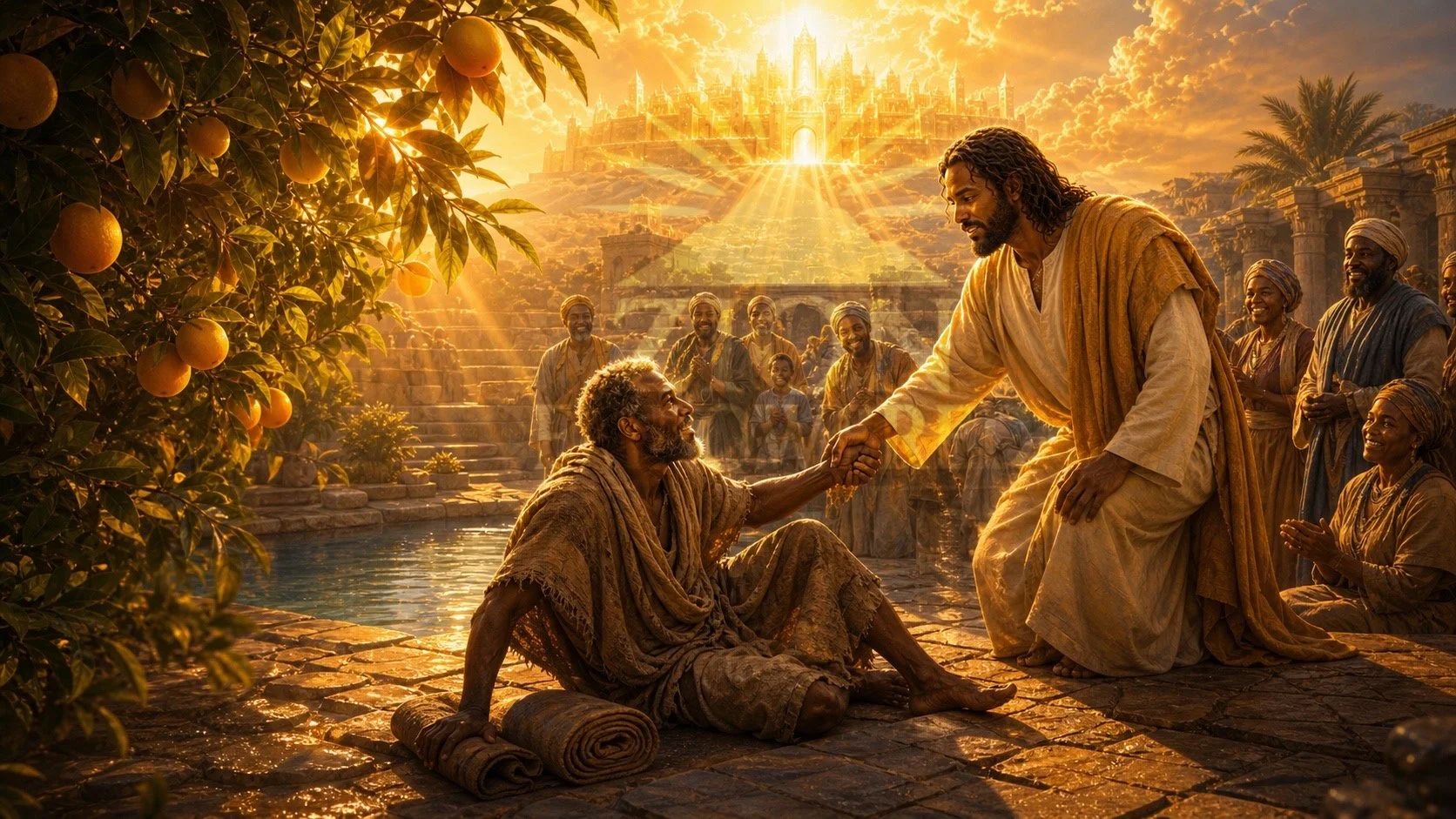
The Father Is Still Working
Opening Preamble
Before Jesus tells a wounded man to pick up his mat,
Torah teaches Israel not to pick fruit too soon.
Before the man at the pool learns how to walk,
the people in the land must learn how to wait.
Before John shows us healing on the Sabbath,
Leviticus shows us fruit that must become holy before it becomes useful.
Because God does not only heal bodies.
God orders appetites.
God does not only give increase.
God teaches restraint.
God does not only say, “Rise.”
He also says, “Wait.”
Kedoshim means holy ones.
It is spoken to the whole community:
parents and children, workers and neighbors, farmers and strangers, elders and the poor at the edge of the field.
Holiness is not a private glow.
It is public order.
It is how we handle fruit, hunger, time, mercy, anger, and the person we would rather not see.
And tucked inside this holiness chapter is a quiet command:
When you enter the land and plant a tree,
do not eat its fruit for three years.
In the fourth year, let the fruit be holy.
Let it become praise.
In the fifth year, then you may eat freely.
That is a strange word to hurried people.
We live in a world that says:
If it grows, grab it.
If it opens, enter it.
If it shines, chase it.
If it feels good, claim it.
But Torah says:
Not yet.
Not because the fruit is evil.
Not because God is cruel.
But because some blessings must pass through praise before they pass through appetite.
Some fruit is real, but it is not ready.
Then John brings us to a man who has been lying beside a pool too long.
Jesus sees him.
Jesus speaks to him.
Jesus commands him:
Stand up.
Pick up your mat.
Walk.
And immediately the man is healed.
But the miracle happens on the Sabbath,
and the argument begins.
Not over the man’s restored body.
Not over the mercy standing in front of them.
Not over the long years he spent lying down.
The argument begins over the mat.
They noticed what he carried
before they celebrated that he could walk.
That is where the text starts telling on us.
Because Jonah could pity a plant and resent a city. And here, religious eyes can notice a mat and miss a man.
The danger is ancient, but it is still alive:
we can love order more than restoration,
rules more than people,
and our own comfort more than God’s compassion.
Leviticus says:
Do not consume the fruit too soon.
John says:
Do not reduce the miracle to the mat.
Leviticus teaches holiness before possession.
John teaches holiness after healing.
The fruit must become praise.
The healing must become a walk.
And Jesus seals the whole matter with one sentence:
“My Father is always working, and so am I.”
So this Sunday, we stand between a tree and a mat.
The tree asks:
Can you wait before you consume?
The mat asks:
Can you walk after you are healed?
The Sabbath asks:
Can you recognize the Father’s work when mercy does not fit your schedule?
And holiness is learning how to live faithfully between all three.
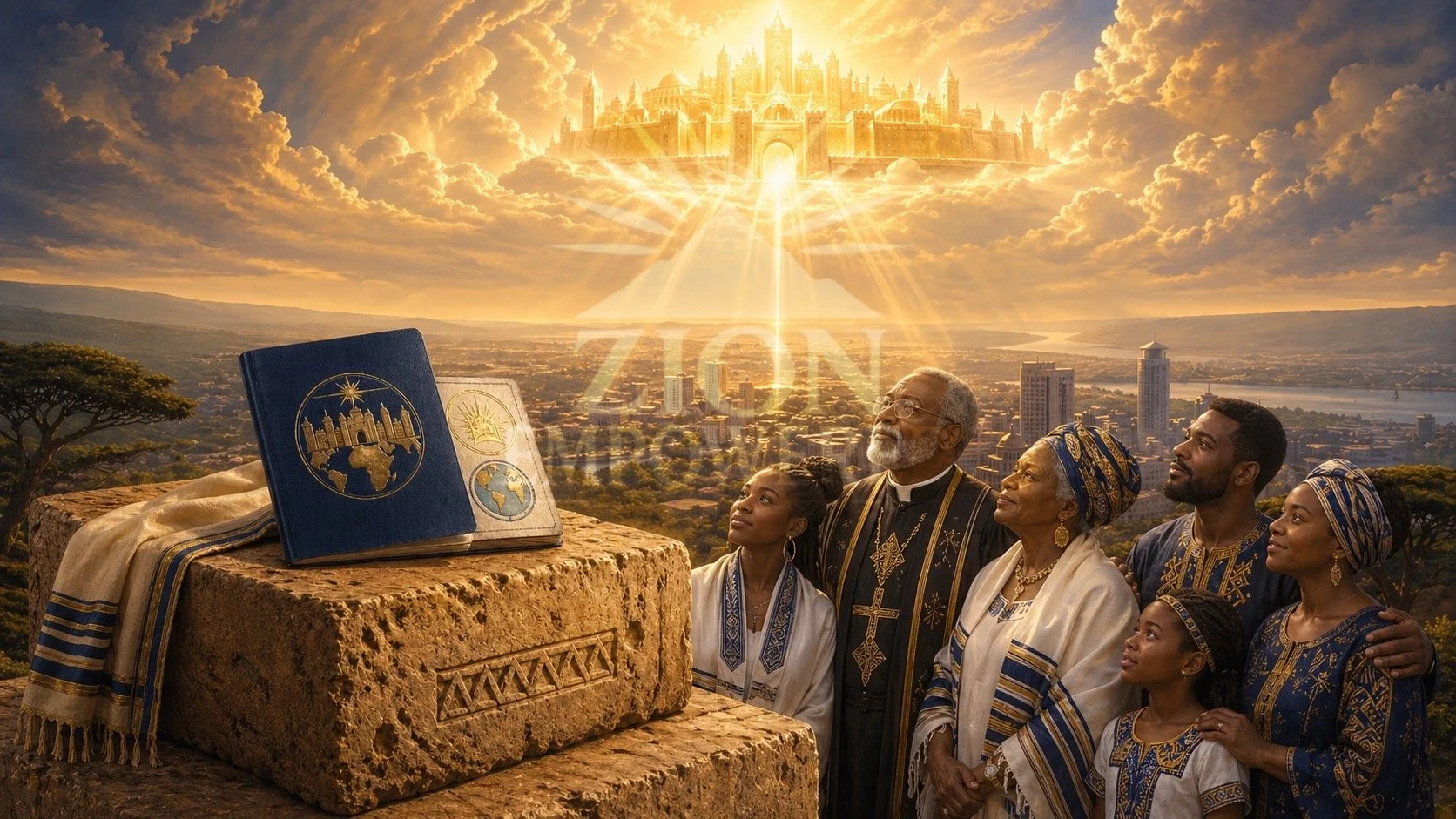
Citizens of Heaven, Neighbors on Earth
Preamble:
Before God sends His people into the city,
He teaches them how to live before His presence.
Before Jeremiah tells the exiles to build houses in Babylon,
Torah teaches Aaron how not to rush into the Holy Place.
Before Peter calls the church “living stones,”
he first tells them to put away deceit, hypocrisy, jealousy, and unkind speech.
Because God does not build a holy people with an unhealed spirit.
Acharei Mot means “after the death.”
It is a word spoken after rupture.
After Aaron’s sons died.
After sacred space was violated.
After worship became careless.
After nearness to God was treated too lightly.
And Jeremiah 29 is also an after-the-death word.
After Jerusalem was broken.
After the people were carried away.
After the old world collapsed.
After the faithful found themselves living in a place they did not choose.
And into that place, God does not say,
“Disappear.”
He does not say,
“Dwindle.”
He does not say,
“Become bitter ghosts in Babylon.”
He says:
Build.
Plant.
Marry.
Multiply.
Seek the peace of the city.
Pray for it.
Then Peter comes along and says:
You are living stones.
You are a spiritual house.
You are a holy priesthood.
You are God’s own people.
Now live honorably among your neighbors.
So this Sunday, we stand between two addresses.
One address is heaven.
That is where our citizenship is.
The other address is earth.
That is where our neighbors are.
And holiness is learning how to live faithfully between the two.